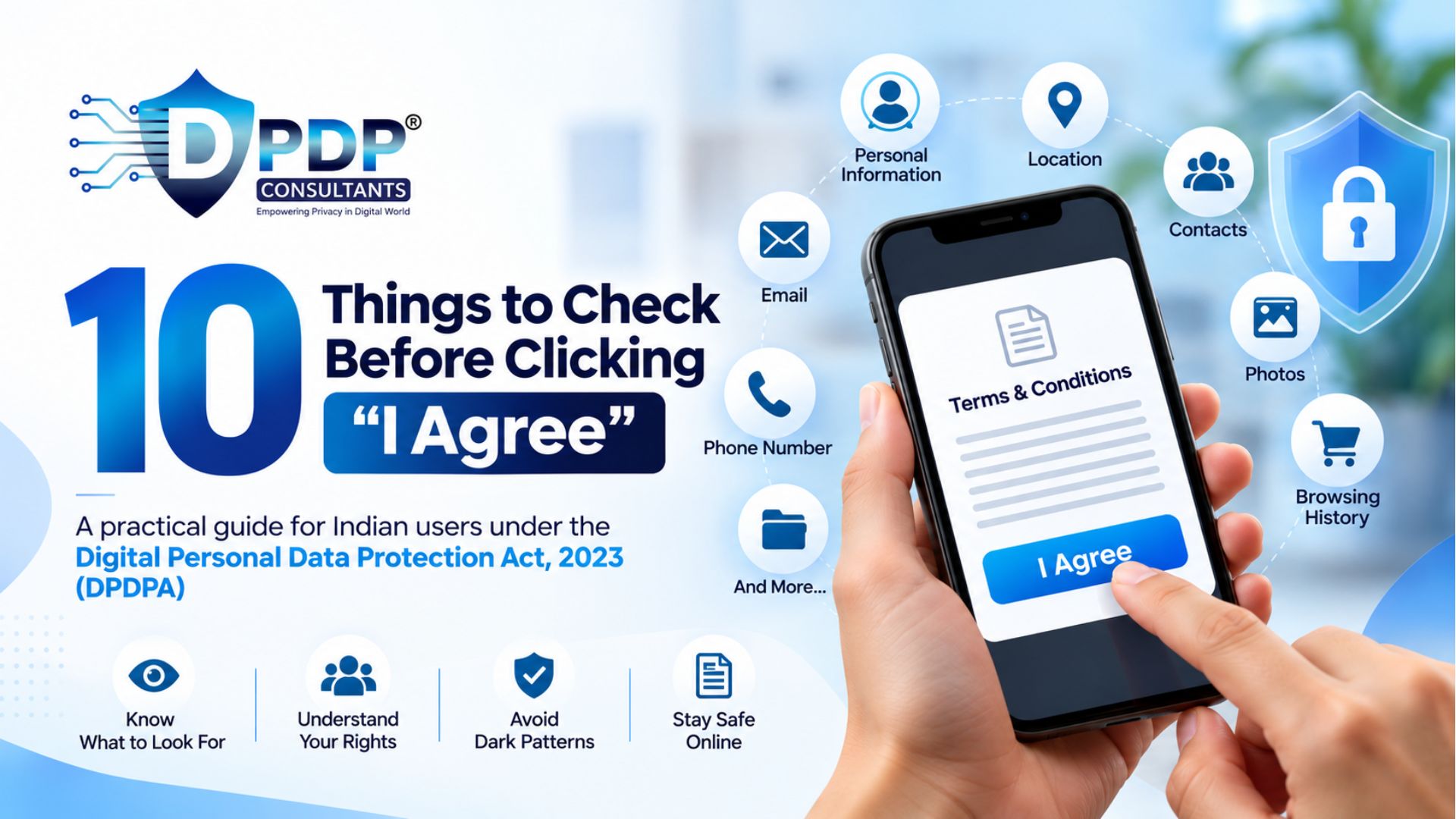
You open a new app. A popup appears. A wall of
text, tiny font, legal jargon. At the bottom, a single button: "I
Agree." You tap it without reading a single word. Within seconds, you have
handed over your name, phone number, email address, location, contacts, photos,
browsing history, and the right for that company to share this data with an
unknown number of "partners" for purposes you never asked about.
You are not alone. Studies consistently show
that over 90% of people accept terms and conditions without reading them. And
until recently, there was very little you could do about it in India, because
there was no comprehensive data protection law to hold companies accountable
for what they did with your personal information after you clicked that button.
That has changed. The Digital Personal Data
Protection Act, 2023 (DPDPA), is now in force. The DPDP Rules, 2025, provide
the operational framework. For the first time in India, you have legally
enforceable rights over your personal data. Companies that collect your data
must follow specific rules about what data they collect from you, how they
collect your consent, what they do with your data, and how long they keep it.
And you have the right to hold them accountable.
But here is the catch: these rights are only
useful if you know what to look for. The law gives you protection, but you must
exercise it. This blog is your practical guide. The next time a consent popup
appears on your screen, these are the 10 things you should check before you
click "I Agree."
The 10-Point Checklist

1. Who Is Collecting Your Data?
The first thing to check is the identity of the
entity asking for your data. Under the DPDPA, the company collecting your
personal data is called the "Data Fiduciary." The consent notice must
clearly identify who this Data Fiduciary is. This is not just a formality. It
tells you who is legally responsible for your data and who you can hold
accountable if something goes wrong.
Many apps and websites are operated by companies
you have never heard of. The shopping app you downloaded may be operated by a
company registered in a different country. The food delivery service may share
your data with a parent company that operates across multiple businesses. The
free game your child plays may be run by an advertising company.
What to look for: Look for
the full legal name and contact details of the company collecting your data. If
the consent notice does not identify the Data Fiduciary clearly, that is your
first warning sign.
Red flag: The consent
notice says "we" or "our company" without ever naming the
actual entity. Or it names a holding company with dozens of subsidiaries, and
you cannot tell which one is responsible for your data.
2. What Personal Data Is Being Collected?
Under the DPDPA, the consent notice must list,
item by item, the specific categories of personal data being collected. This is
a legal requirement, not a suggestion. You have the right to know exactly what
information is being taken from you.
Personal data under the DPDPA means any data
about an individual who is identifiable by or in relation to such data. This
includes your name, phone number, email address, physical address, Aadhaar
number, PAN, bank account details, photographs, biometric data, health
information, location data, browsing behaviour, purchase history, and any other
information that can identify you.
Many apps collect far more data than they need.
A flashlight app should not need access to your contacts. A weather app does
not need your photo gallery. A calculator does not need your location. Yet
these excessive permissions are common because, until now, there was no law
requiring companies to justify every piece of data they collect.
What to look for: The consent
notice should clearly list each category of personal data being collected. Read
this list carefully. Does the app really need all of this information to
provide the service you signed up for?
Red flag: The notice
uses vague language like "we may collect information about you"
without specifying what information. Or the app requests permissions (camera,
microphone, contacts, location) that have nothing to do with its core function.
3. Why Do They Need Your Data? (Purpose Limitation)
This is perhaps the most important check. Under
the DPDPA, personal data can only be processed for the specific purpose stated
in the consent notice. This is called "purpose limitation," and it is
a fundamental principle of the law. A company that collects your data for one
purpose cannot use it for a completely different purpose without obtaining
fresh consent.
For example, if a food delivery app collects
your address to deliver your order, it cannot use that address to send you
unsolicited marketing mailers from its partner companies. If an e-commerce
platform collects your payment details to process a purchase, it cannot share
those details with a lending company to pre-approve you for a loan you never
applied for.
The consent notice must state each purpose
clearly. If the purposes are vague, bundled together, or so broad that they
could mean anything ("to improve our services," "for business
purposes," "for our legitimate interests"), you are essentially
giving the company a blank cheque to use your data however it wants.
What to look for: Read the
stated purposes carefully. Are they specific and tied to the service you are
using? Or are they broad enough to cover almost any use?
Red flag: The notice
says data will be used "for providing services, improving experience,
marketing, research, analytics, and sharing with partners." When
everything is a purpose, nothing is a purpose.
4. Can You Say No to Some Parts? (Granular Consent)
Under the DPDPA, consent must be "free,
specific, informed, unconditional and unambiguous." The word
"specific" is critical here. It means you should be able to consent
to some types of data processing while declining others. You should not be
forced into an all-or-nothing choice.
For instance, you might be willing to share your
email address with an e-commerce platform to receive order updates, but not
willing to share it for marketing emails from 50 partner brands. You might
consent to location tracking while you are actively using a cab-booking app,
but not to continuous background location tracking when the app is closed.
The DPDPA specifically prohibits making access
to a service conditional on consent for data processing that is not necessary
for that service. A news app cannot refuse to show you articles unless you also
agree to share your data with advertising networks. A banking app cannot refuse
to let you check your balance unless you consent to marketing communications.
What to look for: Look for
separate checkboxes or toggles for different types of data collection and
purposes. Can you opt out of marketing while still using the core service? Can
you disable location tracking without losing access to the app entirely?
Red flag: There is
only a single "I Agree" button with no option to accept some
permissions and decline others. Or the app stops working entirely if you
decline any optional permission.
5. How Long Will They Keep Your Data?
Data does not disappear after you stop using a
service. Many companies retain your personal data for years, sometimes
indefinitely, even after you have deleted the app or closed your account. Under
the DPDPA, a Data Fiduciary must erase personal data when it is no longer
needed for the purpose for which it was collected, or when you withdraw your
consent, whichever comes earlier (unless retention is required by another law).
This means a company cannot keep your data
forever "just in case." If you signed up for a free trial, used the
service for a week, and then deleted the app, the company should not still have
your name, email, phone number, and browsing history sitting in its database for
undefined period.
Some retention is legitimate. A bank must keep
your KYC records for at least five years after the relationship ends (RBI
mandate). An e-commerce platform must retain invoices for GST compliance. But
beyond these specific legal requirements, your data should be deleted.
What to look for: Does the
consent notice or privacy policy state how long your data will be retained? Is
the retention period tied to specific legal or business needs, or is it vague
("as long as necessary")?
Red flag: The policy
says data will be retained "for as long as your account is active or as
needed to provide services" with no specific deletion timeline. Or there
is no mention of data retention at all.
6. Who Else Gets Your Data? (Third-Party Sharing)
When you share your data with one company, it
rarely stays with just that company. Your data is often passed to payment
processors, analytics providers, advertising networks, cloud storage providers,
marketing partners, customer support vendors, and a long chain of "Data
Processors" who handle your data on behalf of the original company.
Under the DPDPA, the Data Fiduciary is
responsible for the actions of every Data Processor it engages. But you, as the
Data Principal, have the right to know who these entities are. Your right to
access under Section 11 includes the right to obtain the identities of all Data
Processors with whom your personal data has been shared.
Many consent notices and privacy policies use
phrases like "we may share your data with our trusted partners"
without identifying who those partners are. This is a common tactic to avoid
accountability. Under the DPDPA, you have the right to ask for and receive this
information.
What to look for: Does the
consent notice identify the categories of third parties your data will be
shared with? Can you request a complete list of entities that have received
your data?
Red flag: The policy
mentions sharing data with "affiliates, partners, service providers, and
other third parties" without naming any of them or explaining what data
each receives and why.
7. Can You Withdraw Consent Later?
Under Section 6(4) of the DPDPA, you have the
right to withdraw your consent at any time, and the process for withdrawal must
be as easy as the process for giving consent. This is a powerful provision. If
you gave consent by tapping a button, you should be able to withdraw consent by
tapping a button. You should not have to send a registered letter, fill out a
five-page form, or call a customer service number that never connects.
Upon withdrawal, the Data Fiduciary must stop
processing the personal data that was collected on the basis of your consent.
The company must also inform you of the consequences of withdrawing consent
before acting on it. For example, if withdrawing consent means you can no
longer use certain features of the app, the company must tell you this upfront.
The key test is simplicity. Open the app right
now. Can you find the option to withdraw consent or delete your data? How many
steps does it take? If giving consent took one tap but withdrawing it requires
navigating through seven screens, a verification process, and a 30-day waiting
period, the company is likely violating the spirit and the letter of the DPDPA.
What to look for: Before you
consent, check whether the app or website provides a clear way to withdraw
consent or manage your data preferences. Is it accessible from your account
settings, or is it buried under layers of menus?
Red flag: There is no
visible option to withdraw consent, manage data preferences, or delete your
account. Or the withdrawal process involves sending an email to an address that
auto-replies with a form asking you to justify your decision.
8. Is Your Child's Data Involved?
The DPDPA includes special protections for
children. Under the Act, a "child" is any individual under the age of
18. If a service collects data from children, the Data Fiduciary must obtain
verifiable consent from the child's parent or legal guardian before processing
the data. The law also explicitly prohibits tracking, behavioural monitoring,
and targeted advertising directed at children.
This has significant implications for every
parent in India. The game your child plays on your phone, the educational app
they use for homework, the social media platform they browse, the YouTube
channel they subscribe to: all of these are processing your child's personal
data. And under the DPDPA, they must obtain your verifiable consent as a parent
before doing so.
The next time your child asks to download an app
or create an account, check whether the service asks for parental consent.
Check whether it has a mechanism to verify that a parent is actually providing
that consent (rather than the child clicking "yes, I am over 18").
Check whether the app profiles your child's behaviour for targeted advertising,
which is now illegal under the DPDPA.
What to look for: If you are
a parent, check whether the app or service identifies itself as collecting
children's data and whether it asks for verifiable parental consent. Look for a
children's privacy section in the consent notice.
Red flag: The app has
no age verification whatsoever. Or it asks the user to enter their date of
birth with no follow-up verification, allowing any child to claim they are 18.
9. Where Can You Complain? (Grievance Redressal)
Under Section 13 of the DPDPA, every Data
Fiduciary must establish a grievance redressal mechanism and appoint a
Grievance Officer. The Grievance Officer's contact details must be published
and easily accessible. If you have a complaint about how your data is being
handled, your first step is to approach the company's Grievance Officer.
If the company does not resolve your grievance
within the prescribed timeline (not exceeding 90 days), you can escalate the
complaint directly to the Data Protection Board of India. You do not need a
lawyer. You do not need to pay a fee. The Board is required to accept and
investigate your complaint.
This is a significant shift from the pre-DPDPA
era, where consumers had virtually no recourse if a company mishandled their
data. Now, there is a clear escalation path: complain to the Grievance Officer,
and if unsatisfied, escalate to the Data Protection Board.
What to look for: Before you
consent, check whether the company publishes a Grievance Officer's name and
contact details. Is there a clear complaint submission mechanism? Is the
response timeline stated?
Red flag: The privacy
policy mentions a Grievance Officer but provides no name, email, or contact
information. Or the only way to reach the Grievance Officer is through a
generic "Contact Us" form with no tracking or acknowledgement.
10. What Are Your Rights? (Know Them Before You Need Them)

The DPDPA gives you a set of rights that no
company can take away through its terms and conditions. These rights exist
regardless of what you agreed to in the consent notice, and any clause in a
company's terms that tries to override them is legally void.
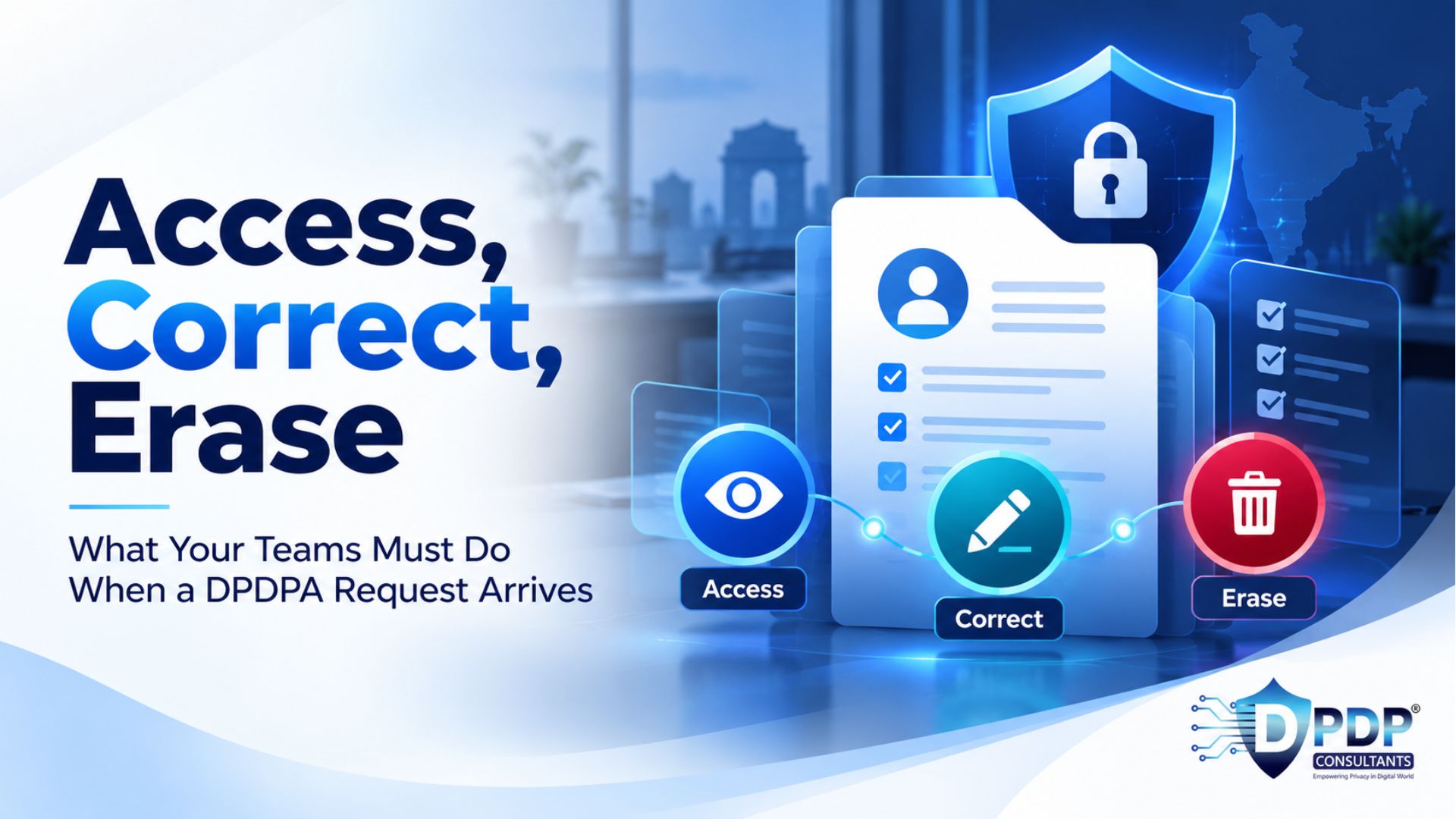
|
Your Right
|
What It Means
|
How to Exercise It
|
|
Right
to Access (S.11)
|
Get
a summary of all your personal data being processed and the identities of
everyone it has been shared with
|
Submit
an access request through the company's published rights request mechanism
|
|
Right to Correction (S.12)
|
Get inaccurate, incomplete, or
misleading data corrected across all systems
|
Submit a correction request specifying
what data is wrong and what it should be
|
|
Right
to Erasure (S.12)
|
Get
your personal data deleted when it is no longer needed or when you withdraw
consent
|
Submit
an erasure request; the company must delete or explain legal reasons for
retention
|
|
Right to Withdraw Consent (S.6(4))
|
Withdraw consent at any time with the
same ease as giving consent; processing must stop
|
Use the consent management option in
the app or website; it should be as easy as clicking 'I Agree' was
|
|
Right
to Grievance Redressal (S.13)
|
Complain
to the Grievance Officer and escalate to the Data Protection Board if
unresolved within 90 days
|
Contact
the published Grievance Officer; if unsatisfied, file a complaint with the
Data Protection Board (no lawyer or fee needed)
|
|
Right to Nomination (S.14)
|
Nominate someone to exercise your data
rights in case of your death or incapacity
|
Submit a nomination request through the
company's rights mechanism
|
The consent notice should describe how you can
exercise your Right to withdraw consent and Right to Grievance Redressal. Under
Rule 14 of the DPDP Rules, 2025, every Data Fiduciary must publish on its
website or app the specific mechanism for submitting rights requests. If a
company's consent notice makes no mention of your rights, or if there is no
accessible mechanism to exercise them, the company is not compliant with the
DPDPA.
Quick Reference: The 10-Point Consent Checklist
Use this table every time you encounter a
consent notice. If the answer to any of these questions is "no" or
"unclear," think twice before clicking "I Agree."
|
#
|
Check
|
What to Look For
|
|
1
|
Who
is collecting your data?
|
Full
legal name and contact details of the Data Fiduciary
|
|
2
|
What data is being collected?
|
Item-by-item list of personal data
categories, not vague descriptions
|
|
3
|
Why
do they need it?
|
Specific,
clearly stated purposes tied to the service you are using
|
|
4
|
Can you say no to some parts?
|
Separate consent options for different
purposes; no bundled consent
|
|
5
|
How
long will they keep it?
|
Defined
retention periods tied to legal or business requirements
|
|
6
|
Who else gets your data?
|
Named categories of third parties and
the reason for sharing
|
|
7
|
Can
you withdraw consent?
|
Easy,
accessible withdrawal mechanism, as simple as giving consent
|
|
8
|
Is your child's data involved?
|
Verifiable parental consent; no
tracking or targeted ads for children
|
|
9
|
Where
can you complain?
|
Named
Grievance Officer with contact details and response timelines
|
|
10
|
What are your rights?
|
Published mechanism to exercise access,
correction, erasure, and other rights
|
Beware of Dark Patterns
Even with the DPDPA in place, many companies use
design tricks, commonly called "dark patterns," to manipulate you
into giving broader consent than you intended. Being aware of these tactics is
just as important as knowing your rights.
Pre-Ticked Checkboxes
You open the consent screen and find that all
the checkboxes are already ticked, including the ones for marketing, data
sharing with partners, and behavioural profiling. You have to actively untick
them to opt out. Under the DPDPA, consent must be "unambiguous," and
pre-ticked boxes that assume your consent are problematic because consent must
be an affirmative action by the Data Principal.
Confusing Language
The consent notice is written in dense legal
jargon, with sentences that run to 80 words, nested conditions, and
cross-references to other documents. The DPDPA requires that consent notices be
in "clear and plain language" and available in English or any other
22 languages specified in the Eighth Schedule. If you cannot understand what
you are consenting to, the notice is failing its legal purpose.
Hidden Opt-Out
The "Accept All" button is large,
bright, and prominently placed. The "Manage Preferences" or
"Decline" option is a small, grey link at the bottom of the page,
almost invisible. This design deliberately steers you toward the option that
benefits the company. A compliant consent mechanism should make it equally easy
to accept or decline.
Forced Consent Bundling
The consent notice bundles essential service
consent with marketing, analytics, and third-party sharing into a single
"I Agree" button. You cannot use the service unless you consent to
everything. Under the DPDPA, making access to a service conditional on consent
for data processing that is not necessary for that service is a violation. You
should be able to consent to what is needed for the service and decline the
rest.
Guilt-Tripping
The option to decline consent is worded in a way
that makes you feel bad: "No, I do not want a personalised
experience" or "I prefer a less secure account." These
manipulative phrases are designed to pressure you into consenting. A fair
consent mechanism presents neutral choices without emotional manipulation.
How DPDP Consultants Helps Businesses Get Consent Right
If you are a business reading this blog, the
question is not whether your customers will start exercising their rights. It
is when. And when they do, every element described above must be in place: a
compliant consent notice, granular consent mechanisms, a data inventory,
defined retention policies, published rights request mechanisms, a functioning
Grievance Officer, and documentation to prove it all.
DPDP Consultants provides end-to-end support for
building this infrastructure.
Consent Management
We implement consent management platforms that
capture, track, and manage consent across every touchpoint: websites, mobile
apps, offline forms, and partner channels. Our solutions support granular
consent (separate toggles for each purpose), multilingual consent notices
(English plus all 22 official Indian languages), version tracking (every change
to the consent notice is logged), and withdrawal mechanisms that are as simple
as the original consent.
Gap Assessment
We audit your current data collection practices,
consent notices, privacy policies, data flows, and rights request mechanisms
against the DPDPA and the DPDP Rules, 2025. The assessment identifies every gap
and provides a prioritised remediation plan.
Privacy Framework Implementation
We design and implement the complete compliance
infrastructure: data inventories, retention policies, consent architectures,
rights request portals, grievance redressal systems, and documentation
frameworks.
DPO as a Service
We provide an experienced Data Protection
Officer who oversees your entire data protection programme, ensures ongoing
compliance, and serves as the bridge between your organisation and the Data
Protection Board.
Cookie Consent
We formulate and implement cookie consent
mechanisms that are fully compliant with the DPDPA, giving users clear choices
about tracking, analytics, and advertising cookies before any data is
collected.
Frequently Asked Questions (FAQs)
Q: Does the DPDPA apply to all
websites and apps I use?
The DPDPA applies to any entity that processes
digital personal data of individuals in India, regardless of where the entity
is based. If a foreign company collects data from Indian users through its
website or app, the DPDPA applies to that processing. However, the Act applies
only to digital personal data (data collected or digitised). It does not apply
to personal data processed entirely offline or to data made publicly available
by the Data Principal themselves.
Q: What if a company does not have
a consent notice?
If a company collects your personal data without
providing a consent notice that meets the requirements of the DPDPA, it is
violating the law. You have the right to file a grievance with the company's
Grievance Officer and, if unresolved, escalate to the Data Protection Board of
India. The absence of a compliant consent notice is itself a compliance
failure.
Q: Can a company refuse to provide
its service if I do not consent to all data collection?
Under the DPDPA, consent must be
"unconditional." A company cannot make access to its core service
conditional on consent for data processing that is not necessary for that
service. If a banking app refuses to show you your account balance unless you
also consent to marketing, that is a violation. However, if the data collection
is genuinely necessary for the service (for example, a cab app needs your
location to dispatch a driver), the company can require that specific consent.
Q: How do I withdraw consent?
Under Section 6(4) of the DPDPA, you can
withdraw consent at any time, and the process must be as easy as giving
consent. Look for consent management or privacy settings in the app or website.
If no such option exists, contact the company's Grievance Officer and request
withdrawal. The company must stop processing your data (except where retention
is required by law) and inform you of any consequences before acting on the
withdrawal.
Q: What happens if a company
ignores my request?
If a company fails to respond to your access,
correction, erasure, or grievance request within the prescribed timeline (not
exceeding 90 days for grievances), you can file a complaint directly with the
Data Protection Board of India. No lawyer is needed, and no fee is charged. The
Board investigates the complaint and can impose penalties on the company.
Q: Are there penalties for
companies that violate the DPDPA?
Yes. Penalties under the DPDPA for a Data
Fiduciary range up to Rs 250 crore for failure to take reasonable security
safeguards resulting in a personal data breach. Non-compliance with Data
Fiduciary obligations (including Data Principal rights, consent requirements,
notice obligations, and children’s data) attracts penalties from up to Rs 50
crore to Rs 200 crore.
Q: Does the DPDPA protect my data
on social media?
Yes. Social media platforms that process
personal data of individuals in India are Data Fiduciaries under the DPDPA.
They must provide compliant consent notices, honour your rights to access,
correction, and erasure, and appoint a Grievance Officer. However, data that
you voluntarily make publicly available on a social media platform may fall
under certain exceptions. The key distinction is between data you choose to
make public and data the platform collects about you behind the scenes
(browsing behaviour, ad interactions, device information), which is fully
covered by the DPDPA.
Q: Can I exercise these rights for
data collected before the DPDPA came into effect?
Yes. The DPDPA applies to existing data as well
as newly collected data. If a company has been processing your personal data
based on consent obtained before the Act came into force, the DPDP Rules
require the company to provide a consent notice "as soon as it is
reasonably practicable." You can exercise your rights over this data,
including requesting access, correction, erasure, and withdrawal of consent.
Your Data. Your Rights. Your Choice.
The next time a consent popup
appears on your screen, you have a choice. You can click "I Agree"
without reading a word, or you can take 60 seconds to check what you are
agreeing to. The DPDPA gives you the legal power to demand transparency, exercise
your rights, and hold companies accountable.
For businesses: DPDP Consultants
builds your complete consent and compliance infrastructure. From Consent
Management and Gap Assessments to Privacy Framework Implementation, DPO as a
Service, Grievance Redressal Systems, and Cookie Consent, we ensure your
organisation is fully DPDPA-compliant.
Contact us today:
Website: www.dpdpconsultants.com
Email: info@dpdpconsultants.com
Stop. Read. Then decide.
Disclaimer: This
document is prepared by DPDP Consultants for informational purposes only. It
does not constitute legal advice and should not be relied upon as a substitute
for professional legal counsel. The information contained herein is based on
the Digital Personal Data Protection Act, 2023, and the DPDP Rules, 2025, as of
October 2026. Laws, regulations, and their interpretations may change. Readers
should consult qualified legal professionals for advice specific to their
circumstances. DPDP Consultants assumes no liability for any actions taken or
not taken based on the contents of this document.