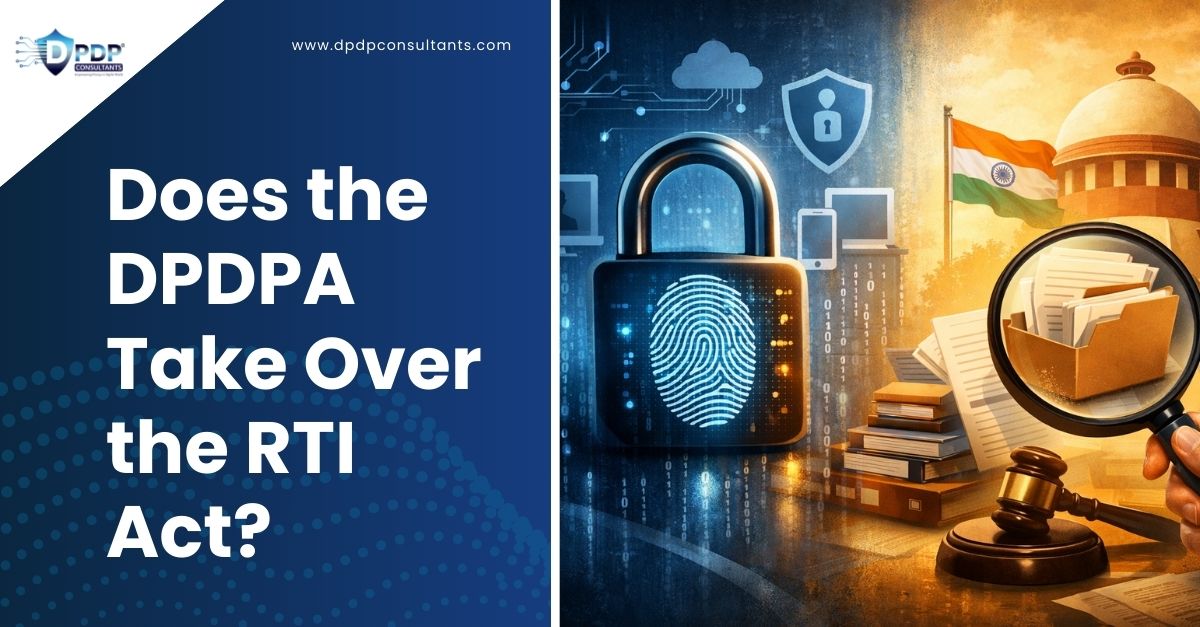
The enactment of
the Digital Personal Data Protection Act, 2023 (DPDPA) has sparked a debate in
legal, policy and civil society circles about whether India’s new data
protection law has effectively overridden or weakened the Right to Information
Act, 2005 (RTI Act), a landmark transparency statute that has been a
cornerstone of democratic accountability.
At the heart of
this debate lies an amendment introduced by the DPDPA to Section 8(1)(j) of the
RTI Act, which deals with exemptions from disclosure of personal information.
The change has generated significant discussion about how privacy and
transparency can coexist in the modern data-driven era.
What Changed in the RTI Act Through the DPDPA
Traditionally,
Section 8(1)(j) of the RTI Act made personal information exempt from disclosure
only if it had no relation to public activity or interest, or if disclosure
would amount to an unwarranted invasion of privacy unless the Central Public
Information Officer or appellate authority was satisfied with that larger
public interest justified disclosure. This “public interest override” was a key
safeguard used by information authorities to balance individual privacy with
transparency.
However, the
DPDPA amended this provision by simplifying the language: the exemption now
generally covers “information which relates to personal information.” This
removes the explicit balancing test that previously allowed release of such
information when the public interest clearly demanded it.
Government’s Position: No Dilution of RTI
The Ministry of
Electronics and Information Technology (MeitY) and the Union government
maintain that this amendment does not dilute the RTI Act or take it over.
According to statements made in Parliament and official clarifications:
- The change merely aligns the RTI
legal text with India’s recognition of the right to privacy as affirmed by
the Supreme Court in Justice K.S. Puttaswamy v. Union of India.
- The government emphasizes that
Section 8(2) of the RTI Act still allows public authorities to disclose
information, even if it falls under exemptions, when the public interest
in disclosure outweighs harm to protected interests.
- Officials have argued that the
earlier “public interest override” was redundant because the broader
statutory protection already permitted such disclosures when justified.
- Government representatives,
including IT Minister Ashwini Vaishnaw, have repeatedly stated that the
amendment is intended to balance privacy and transparency, not override or
weaken the RTI regime.
This
interpretation has also been supported by the Attorney General of India, who
backed the government’s stance that the DPDPA does not diminish citizens’ right
to information under the RTI Act.
Critics’ Concerns: Impact on Transparency
Despite official
assurances, many legal experts, civil society advocates, RTI activists and
journalists argue that the practical effect of the amendment could be quite
different:
- By removing the explicit public
interest consideration from Section 8(1)(j), the revised provision
potentially allows public authorities to categorize broad classes of
information as “personal” and refuse to disclose them outright even if
those details are crucial for public accountability or oversight.
- Under the DPDPA, the definition of
personal data is broad and includes any information that can identify a
person. Consequently, information such as asset declarations, official
conduct data, scheme beneficiary lists or expenditure records
traditionally accessed by citizens to ensure transparency could be treated
as non-disclosable personal information.
- Critics point out that this could
undermine the original intent of the RTI Act, weakening its role as a tool
for fighting corruption and enabling citizen participation in governance.
These concerns
have been translated into constitutional petitions before the Supreme Court,
where petitioners argue that the amendment unduly prioritizes privacy at the
expense of transparency and hampers democratic oversight. Recently, the Supreme
Court agreed to examine these challenges, although it has declined to stay the
contentious provision pending hearing.
Practical Implications for Governance and Civil Society
The debate over
whether the DPDPA takes over the RTI Act underscores a broader policy dilemma:
how to protect individual privacy rights in a digital age, while preserving the
public’s fundamental right to access information about government functioning.
- For citizens and journalists, the concern is that routine refusals citing “personal data”
may reduce access to records essential for accountability.
- For public authorities, the amended provision provides a clearer legal basis to
protect personal data, aligning with privacy jurisprudence and reducing
litigation risk.
- For policymakers, the challenge is to ensure that privacy protections do not
inadvertently become tools to withhold information that legitimately
serves the public interest.
In essence, the
DPDPA does not formally repeal or replace the RTI Act, but its amendment of the
RTI Act represents a significant shift in how personal data is treated within
the transparency framework, a shift that continues to be the subject of legal
scrutiny and public debate.
Conclusion: Harmonization or Supremacy?
The relationship
between the DPDPA and the RTI Act today is not one of outright replacement, but
rather one of interaction and interpretation. The government characterizes the
amendment as a harmonizing move to align the right to privacy with
transparency, while critics fear it tilts the balance toward secrecy. Whether
this legal recalibration ultimately strengthens democratic governance or
weakens public access to information will depend on how courts interpret these
provisions and how public authorities apply them in practice.
Contact
us for a free consultation at info@dpdpconsulants.com or visit
our website DPDP Consultants