Introduction
The Digital Personal Data Protection Act, 2023 (DPDPA) marks a watershed moment for data privacy regulation in India. Enacted to safeguard the digital personal data of Indian citizens, the DPDPA establishes a comprehensive framework that mandates how organizations collect, process, store, and share personal data. For the real estate sector — an industry that thrives on collecting vast amounts of sensitive personal information from buyers, tenants, investors, and brokers — this legislation brings both significant challenges and transformative opportunities.
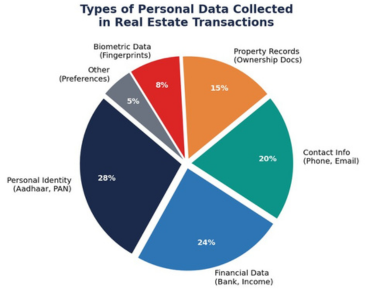
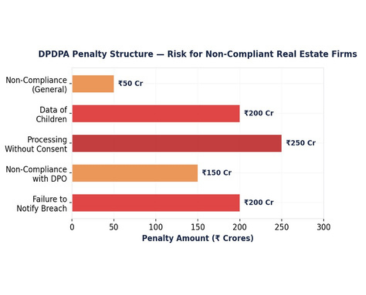
Real estate companies routinely handle Aadhaar numbers, PAN cards, financial records, biometric data, contact details, and property ownership documents. Under the DPDPA, every piece of this personal data must now be collected with explicit consent, processed for lawful purposes only, stored securely, and deleted when no longer needed. Non-compliance can attract penalties of up to ₹250 crores, making DPDPA compliance not just a legal obligation but a business imperative.
This blog provides a comprehensive, sector-specific analysis of how the DPDPA impacts real estate companies, the challenges they face, actionable solutions, and a clear roadmap to achieve full compliance. Whether you are a property developer, real estate broker, housing finance company, or property management firm, this guide is designed to help you navigate the DPDPA landscape with confidence.
1. The Before and After of the DPDPA Era
The Indian real estate sector has historically operated with minimal data governance. The transition from the pre-DPDPA era to the current regulatory environment represents a fundamental shift in how personal data is managed across the property lifecycle.
1.1 The Pre-DPDPA Era: Unregulated Data Practices
Before the DPDPA, real estate companies operated in a largely unregulated data environment. While the Information Technology Act, 2000 provided some basic data protection provisions, it lacked the teeth and specificity needed to govern the complex data flows in real estate transactions. Common practices included collecting excessive personal data without clear justification, sharing customer information with third-party vendors, affiliates, and marketing agencies without explicit consent, retaining data indefinitely with no deletion policies, and storing sensitive documents like Aadhaar copies in unsecured physical and digital formats.
1.2 The Post-DPDPA Era: A New Compliance Standard
The DPDPA introduces a rights-based framework that fundamentally changes how real estate companies must handle personal data. Every data touchpoint — from initial lead capture on a website to post-sale document management — must now comply with strict consent, purpose limitation, and data minimization principles.
Table: Before vs. After DPDPA — Key Changes for Real Estate
Parameter | Before DPDPA | After DPDPA |
Data Collection | Unlimited; no consent required | Purpose-limited; explicit consent mandatory |
Consent Mechanism | Buried in terms & conditions | Clear, specific, informed, and revocable |
Data Storage | Indefinite retention of all records | Retention only as long as purpose exists |
Third-Party Sharing | Freely shared with vendors/brokers | Requires Data Processing Agreements (DPA) |
Customer Rights | No formal rights framework | Right to access, correct, erase, and port data |
Breach Response | No mandatory reporting | 72-hour notification to DPBI and affected persons |
Accountability | No designated officer | Mandatory Data Protection Officer (DPO) |
Penalties | Minimal or none | Up to ₹250 crores per violation |
2. Benefits of DPDPA for Real Estate Companies
While compliance demands investment and organizational change, the DPDPA delivers substantial long-term benefits for real estate companies that embrace it proactively. Far from being just a regulatory burden, DPDPA compliance can become a strategic differentiator in a competitive market.
2.1 Enhanced Customer Trust and Brand Reputation
In an era where data breaches make headlines, homebuyers and investors increasingly prefer companies that demonstrate responsible data handling. DPDPA-compliant real estate firms can use their privacy posture as a marketing advantage, building deeper trust with high-net-worth clients who are especially concerned about the security of their financial and identity data.
2.2 Legal Risk Mitigation and Reduced Liability
With penalties reaching up to ₹250 crores, the financial risk of non-compliance is existential for many real estate companies. Early compliance eliminates this risk and protects companies from class-action lawsuits, regulatory investigations, and reputational damage that can derail ongoing projects and IPO plans.
2.3 Operational Efficiency Through Data Governance
Implementing DPDPA-compliant data management practices forces companies to audit, organize, and streamline their data assets. This results in cleaner databases, faster customer onboarding through standardized consent mechanisms, reduced data storage costs by eliminating unnecessary data, and more efficient CRM and marketing operations built on high-quality, consented data.
2.4 Competitive Advantage in a Fragmented Market
India’s real estate market has over 25,000 active developers and countless brokers. As DPDPA enforcement ramps up, companies that achieve compliance early will differentiate themselves from competitors still struggling with legacy systems. Institutional investors and NRI buyers will increasingly conduct privacy due diligence before committing to transactions, making compliance a prerequisite for premium deals.
2.5 Improved Investor and Partner Confidence
Private equity firms, venture capital funds, and international partners evaluate data governance maturity as part of their investment due diligence. DPDPA compliance signals organizational maturity, robust governance, and reduced risk — all factors that can positively influence valuations and deal terms.
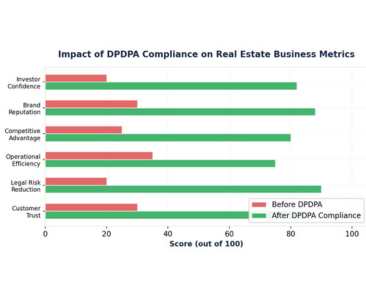
Table: DPDPA Benefits Summary for Real Estate Sector
Benefit Area | Business Impact | Timeline to Realize |
Customer Trust | 15-25% increase in lead conversion | 6-12 months |
Legal Risk Reduction | Avoidance of ₹250 Cr penalty exposure | Immediate |
Operational Efficiency | 20-30% reduction in data management costs | 12-18 months |
Competitive Advantage | Premium positioning in market | 6-9 months |
Investor Confidence | Improved due diligence scores | 3-6 months |
Brand Reputation | Enhanced ESG ratings and public perception | 12-24 months |
3. Challenges Companies Face in Achieving DPDPA Compliance & Solutions
The path to DPDPA compliance in real estate is fraught with industry-specific challenges. The sector’s fragmented structure, reliance on third-party intermediaries, and legacy technology infrastructure create unique compliance hurdles that require tailored solutions.
3.1 Challenge: Fragmented Data Ecosystem
Real estate companies collect data through multiple channels — property portals (99acres, MagicBricks), walk-in registrations, channel partners, referral programs, social media campaigns, and offline site visits. Data often resides in disconnected systems like Excel sheets, local CRMs, WhatsApp groups, and paper files, making it nearly impossible to track consent and data flows comprehensively.
Solution: Centralized Data Governance Platform
Implement a centralized Consent Management Platform (CMP) that integrates with all lead sources and CRM systems. Deploy a unified data lake architecture that consolidates data from all channels into a single, auditable repository. Map every data touchpoint using a Data Flow Mapping exercise to identify where personal data enters, how it moves, and where it is stored.
3.2 Challenge: Third-Party and Channel Partner Compliance
Real estate firms rely heavily on channel partners, brokers, property portals, and marketing agencies who independently collect and process customer data. Under DPDPA, the primary real estate company (as Data Fiduciary) remains liable for the data practices of these Data Processors, creating a significant compliance blind spot.
Solution: Vendor Risk Management Framework
Execute formal Data Processing Agreements (DPAs) with every third party that handles customer data. Establish a vendor audit program with annual compliance reviews. Implement data access controls that limit what data partners can access and for how long. Build a channel partner portal with built-in consent capture mechanisms and data handling guidelines.
3.3 Challenge: Lack of In-House Expertise
Most real estate companies, especially mid-market developers and brokerage firms, lack dedicated privacy professionals, data protection officers, or legal teams with DPDPA expertise. This knowledge gap makes it difficult to interpret regulatory requirements and translate them into operational processes.
Solution: Expert Advisory and DPO-as-a-Service
Engage specialist DPDPA consulting firms like DPDP Consultants who offer end-to-end compliance advisory, DPO-as-a-Service, and employee training programs tailored to the real estate industry. This approach provides immediate access to deep regulatory expertise without the cost of building an in-house privacy team from scratch.
3.4 Challenge: Customer-Facing Consent Management
Real estate transactions involve multiple consent touchpoints — site visit registration, KYC document collection, loan application processing, and post-sale communications. Managing granular, purpose-specific consent across these touchpoints while maintaining seamless customer experience is a significant design and technology challenge.
Solution: Multi-Layered Consent Architecture
Design a tiered consent framework that captures consent at each transaction stage with clear purpose specification. Use progressive consent collection — request only the data needed at each stage, rather than blanket consent upfront. Deploy digital consent forms with audit trails, version control, and easy withdrawal mechanisms integrated into your CRM and customer portals.
Table: Compliance Challenges & Solutions at a Glance
Challenge | Risk Level | Recommended Solution | Priority |
Fragmented Data Ecosystem | High | Centralized Data Governance Platform | Immediate |
Third-Party Compliance | Critical | Vendor Risk Management Framework & DPAs | Immediate |
Lack of In-House Expertise | High | DPO-as-a-Service & Expert Advisory | Month 1-2 |
Consent Management | High | Multi-Layered Consent Architecture | Month 2-4 |
Employee Awareness | Medium | Quarterly Training & Awareness Programs | Ongoing |
Technology Gaps | High | Privacy-by-Design Tech Upgrades | Month 3-6 |
4. Legacy Data Handling: Challenges and Solutions
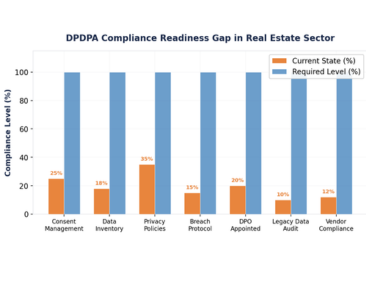
One of the most complex compliance challenges for real estate companies is managing legacy data — the vast repositories of personal data collected over years or even decades before the DPDPA came into effect. This includes physical records in filing cabinets, scanned documents in shared drives, old CRM databases, archived emails, and data stored with former employees or defunct channel partners.
4.1 The Scale of the Legacy Data Problem
A typical mid-to-large real estate developer may have personal data records spanning 10-20 years, covering thousands of customers across multiple projects. This data often lacks any consent records, has no documented purpose for retention, and may be stored in formats that are difficult to audit or search. Physical records like photocopy bundles of Aadhaar and PAN cards may be stored in project site offices with minimal security controls.
4.2 DPDPA Requirements for Legacy Data
The DPDPA applies to all personal data being processed at the time of enforcement, regardless of when it was collected. This means real estate companies must either obtain fresh consent for continued processing of legacy data or delete/anonymize data for which consent cannot be obtained or a lawful purpose no longer exists.
4.3 A Structured Approach to Legacy Data Remediation
• Step 1 — Data Discovery and Inventory: Conduct a comprehensive audit of all legacy data repositories, both physical and digital. Classify data by category (identity documents, financial records, contact information), sensitivity level, and the project/transaction it relates to.
• Step 2 — Purpose Assessment: For each data category, determine whether a legitimate, ongoing purpose exists for its retention. Data related to active legal disputes, ongoing warranties, or regulatory requirements (RERA filings) may have valid retention grounds.
• Step 3 — Consent Re-Engagement: For data that still serves a valid purpose, launch a consent re-engagement campaign. Contact data principals via email, SMS, or registered communication to obtain fresh, DPDPA-compliant consent with clear purpose specification.
• Step 4 — Secure Deletion and Anonymization: For data where consent cannot be obtained or no valid purpose exists, implement secure deletion protocols. Use certified data destruction services for physical records and cryptographic erasure for digital data. Maintain deletion certificates as compliance evidence.
• Step 5 — Documentation and Audit Trail: Maintain a complete record of the legacy data remediation process, including inventory results, purpose assessments, consent responses, and deletion certificates. This documentation is critical for demonstrating compliance during regulatory audits.
Table: Legacy Data Remediation Decision Matrix
Data Category | Typical Volume | Action Required | Timeline |
Active Customer KYC | High | Obtain fresh consent; migrate to secure storage | 0-3 months |
Completed Project Records | Very High | Assess legal retention need; anonymize or delete | 3-6 months |
Marketing Leads (>2 years) | Medium | Re-consent campaign; delete non-respondents | 0-2 months |
Channel Partner Shared Data | High | Audit & recall; execute DPAs or delete | 1-4 months |
Physical Document Archives | Medium | Digitize with consent; securely destroy originals | 3-9 months |
Employee/Vendor Records | Low-Medium | Align with HR compliance; apply retention limits | 2-6 months |
5. Future Improvements After Achieving DPDPA Compliance
Achieving DPDPA compliance is not the end goal — it is the foundation for a more secure, efficient, and customer-centric real estate operation. Companies that treat compliance as a continuous improvement journey will unlock significant long-term advantages.
5.1 Data-Driven Decision Making
Clean, well-governed data is the foundation of effective business intelligence. Post-compliance, real estate companies will operate with high-quality, consented datasets that enable more accurate market analysis, customer segmentation, demand forecasting, and pricing optimization. Marketing campaigns built on consented data consistently deliver higher ROI due to better targeting and engagement rates.
5.2 AI and PropTech Innovation
As India’s PropTech ecosystem matures, technologies like AI-driven property valuation, virtual property tours, predictive maintenance, and smart building management will require robust data foundations. DPDPA-compliant data governance ensures that these innovations are built on a legally sound base, enabling real estate companies to adopt cutting-edge technologies without privacy risk.
5.3 Seamless Cross-Border Transactions
With NRI investments constituting a significant share of India’s luxury real estate market, DPDPA compliance aligns Indian companies with global privacy standards like GDPR and PDPA (Singapore). This alignment simplifies cross-border transactions, eliminates legal friction for international buyers, and positions Indian developers as trustworthy partners in the global property market.
5.4 Stronger RERA and Regulatory Alignment
DPDPA compliance creates synergies with existing regulatory frameworks like RERA (Real Estate Regulatory Authority). Companies with mature data governance practices will find it easier to meet RERA’s transparency and disclosure requirements, reducing the overall regulatory compliance burden and creating a unified governance framework.
5.5 Enhanced Customer Lifecycle Management
Compliant data practices enable real estate companies to build richer, consent-based customer profiles that span the entire property lifecycle — from initial inquiry to post-possession facility management. This creates opportunities for cross-selling, upselling, and referral programs built on trust and transparency rather than intrusive data practices.
6. Roadmap to Achieve DPDPA Compliance
Achieving DPDPA compliance requires a structured, phased approach. The following 12-month roadmap provides a practical framework for real estate companies of all sizes to systematically build their compliance capabilities.
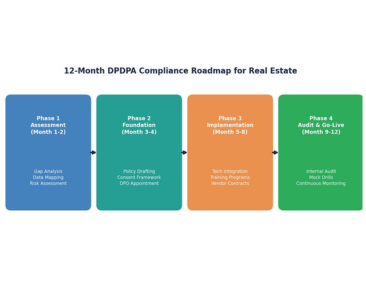
Phase 1: Assessment and Gap Analysis (Months 1–2)
• Conduct a DPDPA gap assessment to benchmark current data practices against regulatory requirements.
• Complete a comprehensive data inventory mapping all personal data flows, storage locations, and processing activities.
• Identify high-risk areas including legacy data repositories, third-party data sharing, and customer-facing processes.
• Appoint a Data Protection Officer (DPO) or engage a DPO-as-a-Service provider.
Phase 2: Policy and Framework Development (Months 3–4)
• Draft DPDPA-compliant privacy policies, consent forms, and data processing agreements.
• Design a consent management framework covering all customer touchpoints.
• Establish data retention and deletion policies aligned with DPDPA’s purpose limitation principle.
• Create a data breach response plan with defined roles, escalation paths, and 72-hour notification protocols.
Phase 3: Technology and Process Implementation (Months 5–8)
• Deploy a Consent Management Platform (CMP) integrated with CRM, website, and lead management systems.
• Implement data encryption, access controls, and audit logging across all systems handling personal data.
• Execute the legacy data remediation plan — consent re-engagement, secure deletion, and anonymization.
• Conduct organization-wide training on DPDPA requirements, data handling procedures, and breach response protocols.
• Onboard all third parties and channel partners onto compliant data processing agreements.
Phase 4: Audit, Testing, and Continuous Monitoring (Months 9–12)
• Conduct an internal compliance audit to verify all policies, processes, and technology controls are functioning as intended.
• Run mock data breach drills to test response readiness and identify gaps in the notification process.
• Establish continuous monitoring mechanisms — regular consent audits, vendor compliance reviews, and data access logging analysis.
• Document all compliance activities and create a compliance evidence repository for regulatory audits.
• Review and update the compliance program quarterly to incorporate regulatory updates, new business processes, and lessons learned.
Table: 12-Month Compliance Roadmap Summary
Phase | Timeline | Key Deliverables | Responsible |
Assessment | Month 1-2 | Gap Report, Data Inventory, DPO Appointment | DPO / Consultant |
Foundation | Month 3-4 | Policies, Consent Framework, Breach Plan | Legal / DPO |
Implementation | Month 5-8 | CMP, Tech Controls, Training, Legacy Remediation | IT / HR / DPO |
Audit & Go-Live | Month 9-12 | Internal Audit, Mock Drills, Monitoring Dashboard | DPO / Management |
7. Conclusion
The Digital Personal Data Protection Act, 2023 is not merely a regulatory checkbox for India’s real estate sector — it is a catalyst for transforming how the industry builds trust, manages data, and creates value. In a market where personal data is exchanged at every transaction stage, from a property search on a website to the final registration at the sub-registrar’s office, DPDPA compliance touches every corner of the business.
The real estate companies that will thrive in this new era are those that view DPDPA compliance not as a cost center but as a strategic investment. By building robust consent mechanisms, implementing strong data governance frameworks, remediating legacy data, and partnering with expert advisory firms, real estate companies can turn compliance into a competitive advantage that drives customer loyalty, investor confidence, and sustainable growth.
The roadmap is clear. The penalties for inaction are severe. And the benefits for those who act decisively are substantial. The time to begin your DPDPA compliance journey is now.
Ready to Start Your DPDPA Compliance Journey? DPDP Consultants offers end-to-end DPDPA compliance advisory, DPO-as-a-Service, and employee training programs tailored specifically for the real estate sector. Our team of certified privacy professionals has helped 100+ organizations achieve compliance. Book a Free Consultation → dpdpconsultants.com |
8. Frequently Asked Questions (FAQs)
Q1: What is the DPDPA and when did it come into effect?
The Digital Personal Data Protection Act, 2023 (DPDPA) is India’s comprehensive data privacy law that governs how organizations collect, process, store, and share digital personal data of Indian citizens. It received Presidential assent on August 11, 2023, and its provisions are being enforced in phases.
Q2: Does the DPDPA apply to all real estate companies in India?
Yes. The DPDPA applies to every entity that processes digital personal data in India, regardless of size. This includes property developers, real estate brokers, housing finance companies, property management firms, co-working space operators, and PropTech startups. Even small brokerage firms that collect customer phone numbers and Aadhaar copies are covered.
Q3: What are the maximum penalties for non-compliance?
The DPDPA prescribes penalties of up to ₹250 crores for the most serious violations, such as processing children’s data without parental consent or failing to implement reasonable security safeguards. Failure to notify data breaches within 72 hours can attract penalties up to ₹200 crores. General non-compliance can result in fines up to ₹50 crores.
Q4: What is a Data Protection Officer (DPO) and do I need one?
A Data Protection Officer is a designated individual responsible for overseeing an organization’s DPDPA compliance program. While the DPDPA mandates a DPO for Significant Data Fiduciaries, it is strongly recommended for all real estate companies given the volume and sensitivity of personal data they handle. Companies can engage DPO-as-a-Service providers to fulfill this requirement cost-effectively.
Q5: How should we handle customer data collected before the DPDPA?
Legacy data collected before DPDPA enforcement must be brought into compliance. This requires conducting a data inventory, assessing whether a valid purpose exists for continued processing, obtaining fresh consent where possible, and securely deleting data for which no lawful basis exists. The Act does not exempt historical data from its requirements.
Q6: What consent mechanisms are required for real estate transactions?
The DPDPA requires free, specific, informed, and unambiguous consent for each purpose of data processing. In real estate, this means separate consents may be needed for property search services, KYC processing, marketing communications, third-party sharing with banks or brokers, and post-sale facility management. Consent must be easy to withdraw.
Q7: How does DPDPA compliance relate to RERA?
DPDPA and RERA are complementary. RERA governs real estate transactions and project disclosures, while DPDPA governs personal data protection. Companies compliant with both frameworks benefit from a unified governance structure. RERA’s transparency requirements align well with DPDPA’s purpose limitation and data minimization principles.
Q8: Can we still share customer data with channel partners and brokers?
Yes, but only under a formal Data Processing Agreement (DPA) that specifies the purpose, scope, and security requirements for data sharing. The channel partner must process data only as instructed by the real estate company (Data Fiduciary). Regular audits of partner data practices are also recommended to ensure ongoing compliance.
Q9: How long does it take to achieve DPDPA compliance?
A well-structured compliance program typically takes 9–12 months to implement fully, depending on the organization’s size, data complexity, and current maturity level. The phased roadmap outlined in this blog provides a practical 12-month timeline covering assessment, policy development, technology implementation, and audit.
Q10: Where can I get help with DPDPA compliance for my real estate company?
Specialist firms like DPDP Consultants (dpdpconsultants.com) provide end-to-end DPDPA compliance services including gap assessments, policy drafting, technology advisory, DPO-as-a-Service, and employee training specifically designed for the real estate sector. Engaging experts can significantly accelerate your compliance timeline and reduce risk.
Disclaimer: This blog is published for informational purposes only and does not constitute legal advice. For specific compliance guidance tailored to your organization, please consult a qualified DPDPA advisor.