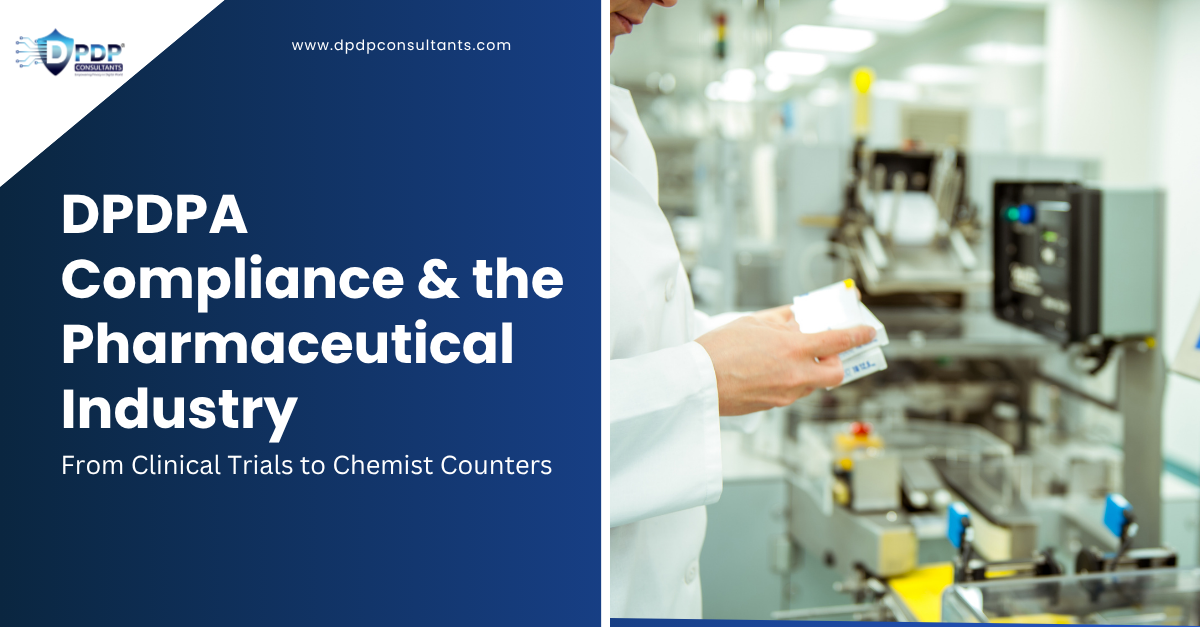
India's pharmaceutical industry is the third
largest in the world by volume and the largest supplier of generic medicines
globally, accounting for over 20% of the global supply. Valued at over USD 50
billion and employing more than 2.7 million people, this sector handles some of
the most sensitive categories of personal data in existence: patient health
records, clinical trial data, genetic information, prescription histories, and
adverse drug reaction reports.
The enactment of the Digital Personal Data
Protection Act, 2023 (DPDPA) and the subsequent Digital Personal Data
Protection Rules, 2025 (notified on 13 November 2025) introduces a statutory
framework that fundamentally alters how pharmaceutical companies collect,
process, store, and share personal data. Until recently, most pharmaceutical
and research entities in India did not consider data protection a legal or
compliance priority. With the DPDPA now in force, this negligence can attract
penalties running into hundreds of crores of rupees.
This comprehensive guide, prepared by DPDP
Consultants, examines every stage of the pharmaceutical value chain, from drug
discovery laboratories and clinical trial sites to manufacturing plants,
medical representative networks, retail pharmacies, and e-pharmacy platforms.
Whether you are a Chief Privacy Officer at a multinational pharmaceutical
company, a compliance head at a contract research organisation (CRO), or a
legal counsel advising digital health startups, this blog provides the
actionable insights you need to build a robust, audit-ready privacy framework.
|
Key
Statistic
The Indian
pharmaceutical industry conducts over 3,500 clinical trials annually, each
generating thousands of individual patient data records. Under the DPDPA,
every data point linked to an identifiable patient demands lawful processing,
informed consent, and robust security safeguards.
|
Before examining sector-specific impacts, it
is essential to understand the foundational provisions of the DPDPA that
directly affect the pharmaceutical ecosystem. The Act establishes a
consent-centric framework with specific provisions for research exemptions,
introduces the concept of Data Fiduciaries and Data Processors, and enforces
strict obligations around data minimization, purpose limitation, and breach
notification.
Key
Definitions for the Pharmaceutical Sector
|
DPDPA Term
|
Definition
|
Pharma Context
|
|
Data Principal
|
The individual whose personal data is processed
|
Patient, clinical trial participant, employee, healthcare
professional (HCP), pharmacy customer
|
|
Data Fiduciary
|
Entity that determines the purpose and means of data
processing
|
Pharmaceutical company, hospital, CRO, e-pharmacy platform,
retail pharmacy chain
|
|
Data Processor
|
Entity processing data on behalf of the Fiduciary
|
Cloud provider, CRM vendor, clinical data management system
(CDMS), third-party analytics firm
|
|
Consent Manager
|
Registered entity enabling consent management
|
Platform managing patient opt-ins for trials, marketing, and
third-party data sharing
|
|
Significant Data Fiduciary (SDF)
|
Designated by Central Government based on data volume and risk
|
Large pharma companies, national pharmacy chains, e-pharmacy
platforms processing data at scale
|
|
Personal Data Breach
|
Unauthorized processing or accidental disclosure
|
Clinical trial database leak, patient record exposure,
prescription data misuse
|
Core
Obligations Under DPDPA for Pharma
The DPDPA mandates that all Data Fiduciaries
in the pharmaceutical sector must obtain free, specific, informed,
unconditional, and unambiguous consent before processing any personal data. A
critical distinction for the pharma industry is that ethical consent obtained
for a medical procedure or clinical trial is not automatically equivalent to
DPDPA-compliant data consent. Even if a participant has signed a medical
consent form, a separate and explicit consent is required for the collection,
storage, analysis, and sharing of their personal data.
The Act does provide a research exemption
under the Second Schedule, which allows processing of personal data for
research, archiving, or statistical purposes without individual consent,
provided that the data is not used to make decisions specific to any Data
Principal. However, pharmaceutical companies must maintain rigorous
documentation of research purposes, apply data minimization principles, and
implement robust security safeguards to qualify for this exemption.
Pharmaceutical R&D is inherently
data-intensive. Drug discovery involves processing vast datasets that may
include patient biomarkers, genetic sequences, disease registries, electronic
health records (EHRs), and real-world evidence (RWE) sourced from hospitals and
diagnostic laboratories. Under the DPDPA, every dataset containing personal
information linked to identifiable individuals falls within the regulatory
ambit.
Data
Touchpoints in Drug Discovery and R&D
|
R&D Stage
|
Data Collected
|
DPDPA Obligation
|
|
Target Identification
|
Patient biomarkers, genetic data, disease registries
|
Research exemption documentation; anonymization where
feasible; DPO oversight
|
|
Preclinical Research
|
Lab personnel data, animal study records linked to researchers
|
Employee consent; purpose-limited retention; secure storage
|
|
Biobank and Tissue Samples
|
Donor identity, medical history, genetic profiles
|
Explicit donor consent; defined retention; withdrawal
mechanism
|
|
AI and ML Model Training
|
Patient datasets for predictive modelling
|
Anonymization or pseudonymization; purpose limitation; no
re-identification
|
|
Real-World Evidence (RWE)
|
EHRs, insurance claims, pharmacy dispensing data
|
Data sharing agreements with hospitals; patient notice; audit
trails
|
|
Collaboration with CROs
|
Shared research datasets containing patient identifiers
|
Contractual obligations with Data Processors; cross-border
transfer compliance
|
The research exemption under the DPDPA offers
significant flexibility for pharmaceutical R&D. However, this exemption is
not a blanket waiver. Companies must demonstrate that the processing is
genuinely for research purposes, that the data is not used to make decisions
about specific individuals, and that adequate security safeguards are in place.
Maintaining detailed Records of Processing Activities (RoPA) is essential for
audit readiness.
Clinical trials represent the most
data-sensitive and legally complex area for pharmaceutical companies under the
DPDPA. India conducts over 3,500 clinical trials annually, and each trial
generates detailed personal data records for every enrolled participant,
including medical history, diagnostic results, treatment responses, adverse
events, and demographic information.
The Dual
Consent Challenge
A fundamental compliance challenge in
clinical trials is the distinction between medical consent and data consent. In
the Indian context, clinical trial participants sign an Informed Consent Form
(ICF) governed by the New Drugs and Clinical Trials Rules, 2019, and overseen
by Ethics Committees. However, the DPDPA introduces a parallel and independent
consent requirement for data processing. Ethical consent is not automatically
equivalent to DPDPA-compliant consent.
Under the DPDPA, consent must be free,
informed, specific, and unambiguous. It must follow a clear notice describing
what data will be collected, why it is needed, and with whom it will be shared.
The individual must retain the right to withdraw consent at any time. This
means pharmaceutical companies and CROs must now implement dual consent
mechanisms: one for the medical procedure and one for data processing.
Clinical
Trial Data Lifecycle
|
Trial Phase
|
Data Involved
|
DPDPA Compliance Requirement
|
|
Screening and Recruitment
|
Patient demographics, medical history, eligibility data
|
Privacy notice at point of collection; separate data consent
from medical ICF
|
|
Phase I to III Trials
|
Vital signs, lab results, adverse events, imaging data
|
Purpose limitation; data minimization; secure transmission to
sponsor
|
|
Data Management (CDMS)
|
Complete patient datasets in electronic data capture systems
|
Encryption; access controls; Data Processor agreements with
CDMS vendor
|
|
Biostatistical Analysis
|
De-identified or pseudonymized datasets
|
Verify anonymization is irreversible; document research
exemption if applicable
|
|
Regulatory Submissions
|
Trial summaries with patient-level data for CDSCO
|
Legitimate use exemption for statutory compliance; secure
transmission
|
|
Post-Trial Data Retention
|
Long-term retention of trial records (up to 15 years)
|
Defined retention schedules; periodic review; secure archival;
erasure protocols
|
Data Retention vs Right
to Erasure
One of the most complex
compliance challenges in the pharmaceutical industry is balancing statutory
retention obligations with Data Principal erasure rights under the DPDPA.
Clinical trial
regulations, pharmacovigilance obligations, GMP requirements, tax laws, and
litigation hold requirements may require pharmaceutical organisations to retain
records for extended durations even after a Data Principal withdraws consent or
requests erasure.
Organisations should
therefore establish documented retention schedules identifying:
- statutory retention obligations,
- legal hold scenarios,
- archival procedures,
- restricted-access retention environments, and
- eventual secure deletion timelines.
Privacy notices should
transparently explain situations where complete erasure may not be immediately
feasible due to overriding legal or regulatory obligations.
|
DPDP
Consultants Insight
We recommend
implementing a Clinical Data Privacy Impact Assessment (CDPIA) before every
trial. This assessment maps all data flows from screening to post-trial
retention, identifies DPDPA compliance gaps, and ensures that dual consent
mechanisms are embedded in the trial protocol from day one.
|
Pharmaceutical manufacturing plants are
data-intensive environments where personal data is collected at multiple
touchpoints. Biometric attendance systems, CCTV surveillance, access control
logs for cleanroom entry, employee health monitoring for GMP (Good
Manufacturing Practice) compliance, and quality assurance systems all generate
personal data falling within the ambit of the DPDPA.
Every sensor collecting employee location
data, every camera recording production floor activity, and every biometric
system at a cleanroom entry point is processing personal data that requires
lawful consent and strict data minimization. Manufacturing organisations must
implement clear privacy notices for employees, define purpose-limited retention
periods for surveillance footage, and ensure that health monitoring data
collected for GMP compliance is not repurposed for performance evaluation or
disciplinary action without separate consent.
Data
Touchpoints in Pharma Manufacturing
|
Manufacturing Stage
|
Data Collected
|
DPDPA Obligation
|
|
Workforce Management
|
Biometrics, attendance, health clearances, shift data
|
Explicit employee consent; purpose-limited retention;
encrypted storage
|
|
Cleanroom Access Control
|
Biometric entry logs, personnel identification, gowning
records
|
Notice to employees; access logs retention limits; no
secondary use
|
|
Quality Assurance
|
CCTV footage, batch records linked to operator identity
|
Data minimization; defined retention; DPO oversight for
surveillance
|
|
Supply Chain and Vendors
|
Vendor personnel data, transporter details, GPS tracking
|
Contractual obligations with Data Processors; breach
notification clauses
|
|
Environmental Health and Safety
|
Employee health records, incident reports, exposure monitoring
|
Sensitive data handling; restricted access; purpose limitation
|
Pharmacovigilance (PV) is a uniquely
challenging area under the DPDPA because it involves the long-term collection,
retention, and cross-border sharing of personal data that is mandated by law.
Adverse Drug Reaction (ADR) reporting, periodic safety update reports (PSURs),
and signal detection all require pharmaceutical companies to process patient
data over extended periods, often spanning the entire commercial life of a
drug.
Under the Pharmacovigilance Programme of
India (PvPI), overseen by the National Coordination Centre at the Indian
Pharmacopoeia Commission (IPC) and the Central Drugs Standard Control
Organisation (CDSCO), pharmaceutical companies are legally obligated to collect
and report Individual Case Safety Reports (ICSRs) containing patient
demographics, medical history, suspect drug details, and adverse event
descriptions.
While such processing may be legally required
and thus potentially covered by the DPDPA's legitimate use exemptions for
statutory compliance, pharmaceutical companies must still limit data use to
necessity, secure data appropriately, and maintain comprehensive audit trails.
The key principle is that a statutory obligation to report does not create a
blanket exemption from all DPDPA obligations. Purpose limitation, security
safeguards, and Data Principal rights still apply.
Pharmacovigilance
Data Compliance Framework
|
PV Activity
|
Data Involved
|
DPDPA Compliance Action
|
|
ADR Collection
|
Patient identity, medical history, suspect drug, reaction
details
|
Legitimate use for statutory compliance; data minimization;
secure transmission
|
|
ICSR Reporting to CDSCO
|
Individual case safety reports with patient-level data
|
Statutory exemption applies; encrypt submissions; maintain
audit trail
|
|
PSUR Preparation
|
Aggregated safety data with potential patient identifiers
|
Anonymize where possible; purpose-limited access; retention
schedule
|
|
Signal Detection
|
Large-scale patient datasets for safety pattern analysis
|
Research exemption documentation; no individual-specific
decisions
|
|
Cross-Border Safety Reporting
|
ICSRs shared with global headquarters or WHO
|
Cross-border transfer compliance; negative list review;
contractual safeguards
|
|
Post-Marketing Surveillance
|
Long-term patient follow-up data
|
Ongoing consent management; periodic retention review; right
to erasure consideration
|
India's pharmaceutical industry employs over
600,000 medical representatives (MRs) who form the backbone of pharmaceutical
marketing and distribution. MRs collect and process significant volumes of
personal data, including healthcare professional (HCP) contact details,
prescription patterns, hospital visit logs, and doctor meeting notes stored in
sales force automation (SFA) and CRM platforms.
Under the DPDPA, the personal data of both
the MRs themselves (employee data) and the HCPs they interact with (third-party
data) falls within the regulatory ambit. CRM platforms used to track doctor
interactions, prescription analytics platforms that aggregate prescriber data,
and sales incentive systems linked to individual MR performance all constitute
processing of personal data requiring lawful consent, privacy notices, and
purpose limitation.
Pharmaceutical companies must ensure that HCP
data collected by MRs is processed with appropriate notice and consent, that
CRM vendors operating as Data Processors have DPDPA-compliant contractual
terms, and that prescription analytics do not enable re-identification of
individual patients from aggregated dispensing data. Sales incentive systems
that link MR performance to prescriber targeting must be reviewed for purpose
limitation compliance.
Retail pharmacies and chemist shops across
India are the final touchpoint in the pharmaceutical value chain, and they
handle personal data at every transaction. Prescription records containing
patient identity and medication details, Aadhaar verification for government
subsidised schemes, loyalty programme enrolments, and purchase histories all
constitute personal data processing under the DPDPA.
Customer
Data at Retail Pharmacies
|
Touchpoint
|
Data Collected
|
DPDPA Requirement
|
|
Prescription Dispensing
|
Patient name, doctor details, medication, dosage
|
Privacy notice; purpose-limited retention; no secondary
marketing without consent
|
|
Government Scheme Verification
|
Aadhaar, beneficiary ID, income proof
|
Strict purpose limitation; immediate deletion after
verification; encrypted processing
|
|
Loyalty and Rewards Programmes
|
Name, phone, email, purchase history, health preferences
|
Granular consent at enrolment; opt-out mechanism; data
portability on request
|
|
Home Delivery Services
|
Address, phone number, medication details, delivery schedules
|
Consent for delivery partner data sharing; defined retention;
secure transmission
|
|
Insurance and TPA Claims
|
Patient ID, insurance details, prescription data, claim
amounts
|
Data sharing agreements with insurers; purpose limitation;
patient notification
|
|
Controlled Substance Records
|
Buyer identity, prescription details for Schedule H and H1
drugs
|
Statutory retention requirements; restricted access; audit
trail
|
|
Practical
Tip from DPDP Consultants
Retail pharmacy
chains should implement a simple digital privacy notice displayed at the
billing counter or on the POS screen. This notice should inform customers
about what data is collected, its purpose, retention period, and their right
to withdraw consent. For loyalty programmes, a separate opt-in mechanism with
granular choices (SMS alerts, email offers, third-party sharing) is
essential.
|
India's e-pharmacy market, while currently
representing approximately 3% of total pharmaceutical sales, is growing rapidly
and processing personal data at an unprecedented scale. Platforms such as
online medicine ordering apps, teleconsultation services, digital diagnostics,
and health management applications collect extensive personal data including
patient identity, prescription uploads, medication history, health vitals,
location data, and payment information.
Under the DPDPA, e-pharmacy platforms are
classified as Data Fiduciaries with full statutory obligations. The processing
of health-related personal data through digital platforms raises heightened
privacy concerns due to the volume, sensitivity, and potential for
cross-platform aggregation of patient information.
E-Pharmacy
Data Compliance Areas
|
Digital Health Touchpoint
|
Data Involved
|
Compliance Action Required
|
|
User Registration and KYC
|
Name, phone, email, address, ID proof
|
Privacy notice at registration; granular consent; encrypted
storage
|
|
Prescription Upload and Verification
|
Prescription images, doctor details, medication list
|
Purpose limitation; retention schedule; secure image storage
and transmission
|
|
Teleconsultation
|
Video and audio recordings, symptoms, diagnosis, prescriptions
|
Explicit consent for recording; defined retention; doctor and
patient notice
|
|
Medicine Ordering and Delivery
|
Medication orders, delivery address, payment details
|
Data minimization; secure payment processing; delivery partner
data agreements
|
|
Health Tracking and Vitals
|
Blood pressure, glucose levels, weight, medication adherence
|
Sensitive health data safeguards; no third-party sharing
without consent
|
|
AI-Powered Recommendations
|
Purchase history, health profile, behavioural data
|
Transparency on algorithmic profiling; opt-out rights; no
automated health decisions
|
Children's data requires special attention in
the e-pharmacy context. If a parent orders medication for a minor through an
e-pharmacy platform, the platform must be aware that processing a child's data
(below 18 years under DPDPA) triggers additional safeguards, including
verifiable parental consent and a prohibition on tracking or behavioural
monitoring of the child.
Data
Principal Rights in the Pharmaceutical Context
- The DPDPA grants Data Principals several statutory rights relating to
their personal data. Pharmaceutical companies, CROs, e-pharmacy platforms,
hospitals, and retail pharmacy chains must establish operational mechanisms to
respond to such requests within prescribed timelines.
- In the pharmaceutical sector, these rights may interact with sectoral
retention obligations under clinical trial regulations, pharmacovigilance requirements, GMP
documentation obligations, and statutory recordkeeping mandates.
- Pharmaceutical organisations should therefore implement structured
governance mechanisms to balance Data Principal rights with mandatory legal
retention obligations.
- Organisations should maintain documented procedures for evaluating
whether data erasure requests can be fully honoured where sectoral regulations
require long-term retention of clinical, pharmacovigilance, or
prescription-related records.
For pharmaceutical companies operating across
multiple jurisdictions, understanding how the DPDPA compares with the European
Union's General Data Protection Regulation (GDPR) and the United States Health
Insurance Portability and Accountability Act (HIPAA) is essential for building
a harmonised global compliance strategy.
|
Parameter
|
DPDPA (India)
|
GDPR (EU)
|
HIPAA (USA)
|
|
Scope
|
All digital personal data
|
All personal data (digital and physical)
|
Protected Health Information (PHI) only
|
|
Applicability
|
All sectors processing personal data
|
All sectors processing personal data
|
Healthcare providers, insurers, business associates only
|
|
Lawful Basis
|
Consent + Certain Legitimate Uses
|
6 lawful bases including Legitimate Interest
|
Treatment, Payment, Healthcare Operations + consent for others
|
|
Health Data Classification
|
No separate category; all personal data treated equally
|
Special category requiring explicit consent
|
Protected Health Information (PHI) with specific safeguards
|
|
Research Exemption
|
Available under Second Schedule conditions
|
Available under Article 89 with safeguards
|
Limited; requires IRB waiver or de-identification
|
|
Consent Standard
|
Free, specific, informed, unambiguous
|
Same standard; explicit for special categories
|
Written authorization for PHI; opt-out for certain uses
|
|
Breach Notification
|
72-hour SLA to Board + affected individuals
|
72-hour SLA to DPA; without undue delay to individuals
|
60 days to individuals; annual report to HHS
|
|
Cross-Border Transfer
|
Negative list (allowed unless restricted)
|
Restricted; adequacy or safeguards required
|
Business Associate Agreements required
|
|
Children's Data
|
Below 18; verifiable parental consent
|
Below 16 (varies by member state)
|
Parental consent under COPPA (below 13)
|
|
Maximum Penalty
|
INR 250 Crore (approx. USD 30 million)
|
EUR 20 million or 4% global turnover
|
USD 1.5 million per violation category per year
|
A critical difference for pharma companies is
that the DPDPA does not create a separate category for health data, unlike the
GDPR which classifies it as a special category requiring explicit consent, or
HIPAA which applies exclusively to Protected Health Information. Under the
DPDPA, patient health data is treated as personal data with the same
obligations as any other category, though the sensitivity of health data may
influence the Data Protection Board's assessment of security adequacy and
penalty severity.
The absence of a legitimate interest basis
under the DPDPA is particularly impactful for pharmaceutical companies that
rely on this basis under GDPR for activities such as pharmacovigilance, medical
information services, and HCP engagement. Under the DPDPA, these activities
will require either explicit consent or reliance on the statutory compliance or
research exemptions.
The DPDPA introduces substantial financial
penalties that should command the attention of every pharmaceutical industry
stakeholder. The penalty structure is designed to be proportionate yet
deterrent, with fines calibrated to the nature and severity of the violation.
|
Violation Type
|
Maximum Penalty
|
Pharma Sector Example
|
|
Failure to take reasonable security safeguards
|
INR 250 Crore (~USD 30M)
|
Clinical trial database hacked due to inadequate encryption;
patient health records exposed
|
|
Failure to notify Data Protection Board of breach
|
INR 200 Crore (~USD 24M)
|
E-pharmacy platform breach affecting 500,000 patient records
not reported within 72 hours
|
|
Non-compliance with obligations regarding children
|
INR 200 Crore (~USD 24M)
|
E-pharmacy collecting minor patient data without verifiable
parental consent
|
|
Failure to comply with Significant Data Fiduciary duties
|
INR 150 Crore (~USD 18M)
|
Large pharma company classified as SDF fails to appoint DPO or
conduct DPIA
|
|
Breach of any other provision of the Act
|
INR 50 Crore (~USD 6M)
|
Medical representatives using HCP data for secondary marketing
without consent
|
|
Non-compliance by Data Principal (false complaint)
|
INR 10,000
|
Individual filing a fraudulent data erasure request against a
pharma company
|
|
Risk
Alert
Penalties under DPDPA
are per-instance and cumulative. A single clinical trial data breach
affecting multiple patients, combined with failure to notify and inadequate
security measures, could attract penalties across multiple violation
categories simultaneously. For a large pharmaceutical company or CRO,
aggregate exposure could run into hundreds of crores.
|
The DPDPA Rules adopt a pragmatic phased
implementation strategy. Understanding these timelines is critical for
pharmaceutical businesses to plan their compliance journey effectively.
|
Phase
|
Timeline
|
What Takes Effect
|
Action for Pharma Sector
|
|
Phase 1
|
November 2025 (Immediate)
|
Data Protection Board constitution; governance rules
|
Monitor DPB appointments; begin internal data mapping and gap
assessment
|
|
Phase 2
|
November 2026 (12 months)
|
Consent Manager registration and operations
|
Evaluate Consent Manager integration for clinical trials and
patient data flows
|
|
Phase 3
|
May 2027 (18 months)
|
Full enforcement of all provisions
|
Complete compliance: DPO appointment, DPIA, dual consent
systems, vendor audits, staff training
|
With the full enforcement deadline of May
2027 approaching, pharmaceutical businesses have a narrow window to achieve
compliance. The volume of work required, from implementing dual consent in
clinical trials to auditing CRM vendor contracts to training medical
representatives and pharmacy staff, demands immediate and coordinated action
across all functions.
The following checklist provides a structured
framework for pharmaceutical industry stakeholders to assess and track their
DPDPA compliance readiness across the entire value chain.
|
#
|
Compliance Area
|
Key Actions
|
Priority
|
|
1
|
Data Inventory and Mapping
|
Map all personal data flows from R&D to retail; identify
Data Fiduciary and Processor roles across the organisation
|
Critical
|
|
2
|
Dual Consent Framework
|
Implement separate data consent mechanisms for clinical trials
distinct from medical ICFs; review all existing consent forms
|
Critical
|
|
3
|
Privacy Notices
|
Draft clear, specific privacy notices for each data touchpoint
(clinical trials, pharmacy, e-pharmacy, employee, HCP)
|
Critical
|
|
4
|
Security Safeguards
|
Encrypt patient data at rest and in transit; conduct VAPT;
implement role-based access controls and monitoring
|
Critical
|
|
5
|
Breach Response Plan
|
Develop 72-hour breach notification protocol; train incident
response team; conduct tabletop exercises
|
High
|
|
6
|
Vendor and Processor Agreements
|
Update all Data Processor contracts (CROs, CDMS vendors, CRM
platforms) with DPDPA-compliant clauses
|
High
|
|
7
|
Research Exemption Documentation
|
Maintain detailed records demonstrating eligibility for Second
Schedule research exemptions
|
High
|
|
8
|
Pharmacovigilance Compliance
|
Review PV data flows for DPDPA alignment; document statutory
exemption basis; secure cross-border transfers
|
High
|
|
9
|
DPO Appointment (if SDF)
|
Appoint India-resident DPO; ensure independence; establish
reporting line to the Board
|
High
|
|
10
|
Clinical Trial DPIA
|
Conduct Data Protection Impact Assessment for all ongoing and
planned clinical trials
|
High
|
|
11
|
MR and Sales Force Training
|
Train all medical representatives on DPDPA-compliant HCP data
handling and CRM usage
|
Medium
|
|
12
|
Retail Pharmacy Training
|
Conduct DPDPA awareness training for pharmacy staff on
prescription data and loyalty programme compliance
|
Medium
|
|
13
|
E-Pharmacy and Digital Health Review
|
Audit all digital health platforms for consent, data
minimization, and children's data safeguards
|
Medium
|
|
14
|
Data Retention Policy
|
Define retention periods for each data category (trial data,
PV records, prescriptions); automate erasure
|
Medium
|
|
15
|
Cross-Border Transfer Review
|
Review all international data flows (clinical data to
sponsors, PV data to WHO); ensure no restricted jurisdictions
|
Medium
|
|
16
|
Grievance Redressal Mechanism
|
Establish Data Principal rights handling process; respond
within prescribed timelines
|
Medium
|
The DPDPA is not merely a regulatory burden
for the pharmaceutical industry. It is an opportunity to build deeper trust
with the patients, healthcare professionals, and communities that the industry
serves. In a sector where personal data is inextricably linked to health,
wellbeing, and life itself, the obligation to protect that data is both a legal
requirement and an ethical imperative.
The transformation required is significant.
From implementing dual consent mechanisms in clinical trials to retraining
pharmacy staff on prescription data handling, from renegotiating CRO contracts
to building pharmacovigilance data compliance frameworks, every function within
a pharmaceutical organisation must contribute to the privacy compliance
journey.
However, this transformation is also a
competitive advantage. Pharmaceutical companies that demonstrate robust data
protection practices will find it easier to attract clinical trial
participants, build stronger relationships with healthcare professionals,
secure global partnerships, and maintain the regulatory goodwill that is
essential in a heavily regulated industry. In a market where patients are
increasingly aware of their data rights, the pharmaceutical company that
respects and protects personal data will earn lasting trust and loyalty.
Need Expert DPDPA Compliance Guidance for Your Pharmaceutical Business?
DPDP Consultants specializes in end-to-end DPDPA compliance for the pharmaceutical and life sciences sector. From clinical trial data mapping and dual consent architecture to pharmacovigilance compliance and vendor audits, our team of certified privacy professionals partners with pharmaceutical companies, CROs, and digital health platforms to build privacy frameworks that protect both your patients and your business.
Contact us: info@dpdpconsultants.com | www.dpdpconsultants.com
Disclaimer:
This blog is prepared for informational purposes only and does
not constitute legal advice. While every effort has been made to ensure
accuracy, readers should consult qualified legal professionals for specific
compliance guidance. The DPDPA and its Rules may be subject to further
amendments and interpretive guidance from the Data Protection Board of India.