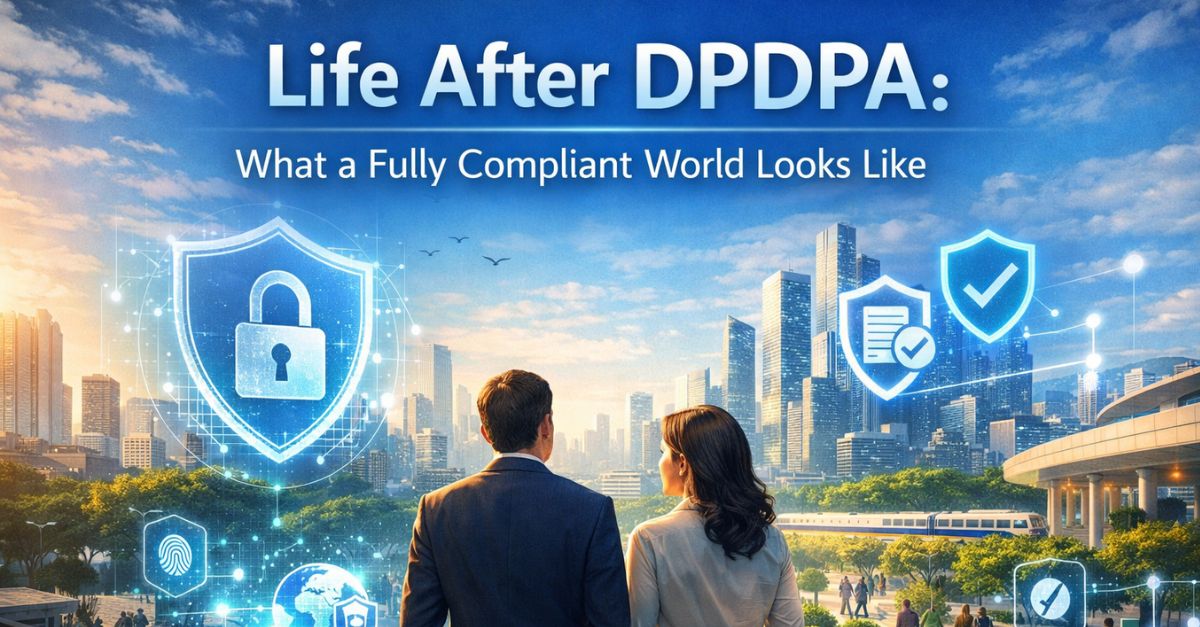
Imagine waking
up in a world where every bit of your personal data is respected, every company
plays by the rules, and trust is not just a marketing slogan. It is the
default. This is the story of that world.
There was a
time not so long ago when downloading a simple flashlight app meant
surrendering your contacts, location, and browsing history to a faceless server
halfway across the world. We clicked “I Agree” like a reflex. We never read,
never questioned, and never truly knew. Our phone numbers circulated in
databases we had never heard of. Our browsing habits were packaged and sold to
the highest bidder before we even finished our morning chai. Our children’s
school photos, uploaded innocently, became training data for algorithms we
never consented to.
But that world
is gone. It is finished, buried under the weight of its own absurdity. This is
the story of what came after. This is life after the Digital Personal Data
Protection Act reshaped not just India’s digital landscape but the very
relationship between people and the technology they use every single day.
Chapter One
What “Life After DPDPA” Actually Means
Let us be clear
about what we are imagining here. “Life After DPDPA” is not a date on the
calendar. It is not the day the law was passed, the day the first fine was
issued, or the day a minister gave a speech about digital empowerment. It is a
state of being. It is a world where every Data Fiduciary, from the
neighbourhood grocery delivery app to the largest multinational bank, from the
regional hospital chain to the global social media giant, has internalized the
principles of the Digital Personal Data Protection Act, 2023.
This is not out
of fear or because the penalties are steep. It is by design, by conviction, and
by understanding that protecting personal data is not a legal burden. It is the
foundation of a trustworthy digital society.
In this world,
consent is not a wall of legal text designed to confuse you into clicking
“Accept All” at two in the morning. It is a clear and honest question. For
example: “May we use your location to show you nearby restaurants? Here is
exactly what we will do with it, and here is how long we will keep it.” When
you say no, the app still works. It simply does not track you. The features
that do not require your location continue to function perfectly. It is simple
and yet revolutionary.
The DPDPA did
not just create rules. It created a new culture. It fundamentally altered the
power dynamic between those who collect data and those who generate it.
Companies stopped treating personal data as an asset to be harvested and
monetized. Instead, they began treating it as a responsibility to be honoured.
It became a temporary trust rather than a permanent possession.
The Act gave
India’s 1.4 billion citizens, its “Data Principals,” something they had never
truly possessed before: genuine, enforceable, and meaningful control over their
digital identities.
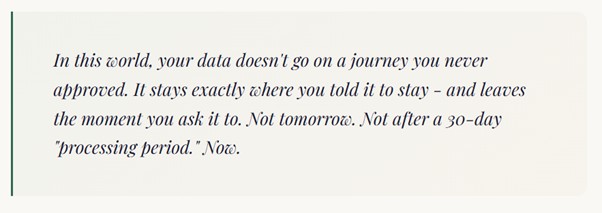
In this world,
your data does not go on a journey you never approved. It stays exactly where
you told it to stay and leaves the moment you ask it to. Not tomorrow, not
after a processing period, but immediately.
Think about what that means in practice. You download a fitness app. It asks
for access to your health data, such as heart rate, steps, and sleep patterns.
It explains in plain language that this data will be used to personalize your
workouts and will be stored securely for the duration of your subscription.
When you cancel, the data is deleted. It is not archived or anonymized for
later use. It is deleted completely, and you receive confirmation.
This is what
“Life After DPDPA” means. It is not a fantasy or science fiction. It is the
logical outcome of a nation deciding that the dignity of its people matters
more than the convenience of its corporations.
Chapter Two
The New Compliance Ecosystem
Walk into any
mid-sized company's office today, and you'll notice something different.
There's a new role on the org chart, and it's not buried in the legal
department next to the fire safety officer. The Data Protection Officer sits in
boardrooms. They shape product decisions from Day One. They have veto power
over features that don't meet privacy standards. They're not the people who say
"no" - they're the people who say "here's how we do this
right."
The compliance
ecosystem that emerged after full DPDPA adoption is nothing like the old world
of dusty audit reports, annual reviews that nobody read, and checkbox exercises
designed to satisfy regulators while changing nothing. It's living, breathing,
and deeply woven into how businesses operate every single day. Consent
management platforms have become as essential as CRMs - perhaps more so,
because a CRM without proper consent management is a liability waiting to
explode. Data mapping tools run continuously, tracking every bit
of personal data from the moment of collection to the moment of deletion,
creating a transparent lineage that any auditor - or any curious user - can
follow.
The
Data Protection Board of India - the body established under DPDPA has evolved
into more than just an enforcement agency waiting to hand out penalties. It has
become a partner to the ecosystem. It publishes clear, practical guidelines
with real-world examples. It runs sandbox programmes where startups can test
data-intensive innovations - from AI-powered medical diagnostics to predictive
agricultural models - under supervised conditions, without the paralysing fear
of accidental non-compliance. It hosts regular open forums where businesses,
civil society, and technologists come together to discuss emerging challenges.
Penalties exist, yes - significant ones, up to hundreds of crores - but they're
rarely needed anymore, because the cost of non-compliance is no longer just
financial. It's reputational. And in this world, reputation is the hardest
currency there is.
Third-party
auditing firms have become a thriving industry unto themselves. "DPDPA
Certified" is now a badge that companies display with the same pride that
ISO certifications once adorned factory walls. It's on website footers, on app
store listings, on investor pitch decks. Venture capitalists ask for compliance
scores before they ask for revenue projections. They've learned - some the hard
way, through portfolio companies that imploded after data scandals - that a
single breach of trust can evaporate a company's value overnight. Privacy due
diligence is now as standard as financial due diligence.
And the tools
available to achieve compliance have democratized the process beyond anything
the early sceptics imagined. Cloud-based consent management platforms,
automated data mapping solutions, AI-powered compliance monitors that flag
potential issues before they become violations - these tools are available to
companies of every size, at every price point. The ecosystem didn't just
support the big players. It lifted everyone.
Chapter Three
How DPDPA Transformed Businesses
Here's the part
nobody expected: compliance made businesses better. Not just legally safer. Not
just ethically cleaner. Fundamentally, operationally, competitively better.
In the early
days, there was grumbling. Plenty of it. CFOs winced at the cost of overhauling
data infrastructure that had been cobbled together over decades of unchecked
growth. Engineers groaned about rebuilding consent flows that had been designed
to maximize data collection, not user understanding. Marketing teams mourned
the loss of their sprawling, unchecked data pipelines - the vast rivers of
personal information they had grown addicted to, most of which they barely used
but couldn't bear to give up.
But then
something remarkable happened. When companies were forced to collect only what
they genuinely needed and explain exactly why they needed it, they discovered
an uncomfortable truth: they had been drowning in data they never used. They
had been spending fortunes storing, securing, and managing information that
served no active business purpose. It was digital hoarding on a staggering
scale - expensive, risky, and pointless.
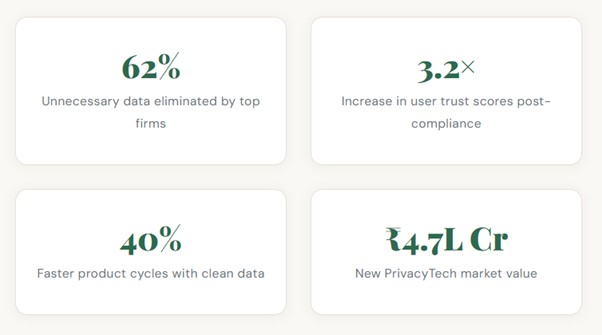
A
major e-commerce platform conducted a comprehensive data audit as part of its
DPDPA compliance journey and found that 62% of the personal data it stored had
no active business purpose. None. It was sitting in databases, eating up
storage, creating security vulnerabilities, and serving absolutely nobody.
After the cleanup, their storage costs dropped dramatically, their systems ran
measurably faster, their security surface area shrank, and their analytics
became sharper because they were finally working with data that actually
mattered.
Trust became a
competitive advantage - arguably the most powerful one in the market. Consumers
started actively choosing platforms that were transparent about data practices.
A mid-sized banking app that showed you exactly what data it held about you - organized
neatly in a personal data dashboard, with the ability to download, correct, or
delete any of it with a single tap - gained three million users in six months.
Not through aggressive advertising or cashback offers, but through word of
mouth. People told their friends, their families, their colleagues: "This
one actually respects you. Use this one."
Product
design philosophy shifted at its core. "Privacy by design" - once an
academic concept that product teams paid lip service to - became the default
methodology. New products were built from the ground up with data minimization
as a principle, not an afterthought. Companies discovered that when you design
for privacy first, you often end up with simpler, cleaner, more elegant
products. The constraint bred creativity. The limitation inspired innovation.
Employee
culture transformed too. Engineering teams took pride in building privacy-first
systems. It became a mark of professional excellence, not a bureaucratic chore.
Recruitment pitches highlighted DPDPA compliance culture as a perk, right
alongside flexible work hours and stock options. The best talent wanted to work
at companies that did things right.
Chapter Four
How Life Changed for Users - the Data Principals
This is where
the story gets personal. Because for all the boardroom transformations and
infrastructure overhauls, the real revolution happened in the pockets and palms
of ordinary people. In the lives of the autorickshaw driver, the schoolteacher,
the retired banker, the college student - the people who were always the most
affected by the data economy but had the least say in how it operated.
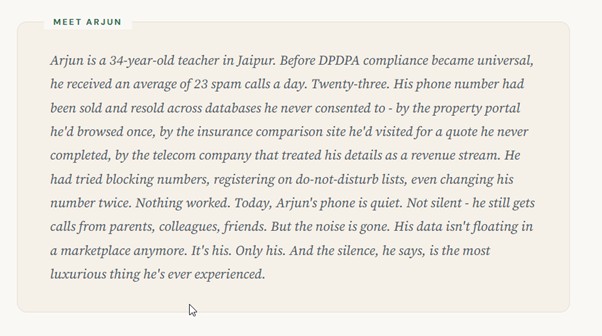
For
users - or as the DPDPA formally calls them, Data Principals - the change is
profound and deeply felt in ways both large and small. Every app now
communicates in plain, accessible language. No more 47-page privacy policies
written in legal jargon so dense that even lawyers needed translators. Instead,
you see simple, layered disclosures: a brief, human-readable summary of what
data is collected, why it's collected, who it might be shared with, and for how
long it will be retained. If you want the full legal details, they're one tap
away. But the summary alone tells you everything you need to make an informed
choice.
The right to
erasure isn't theoretical anymore. It isn't a promise buried in a
terms-of-service document that nobody honours. When you tell a platform to
delete your data, it doesn't vanish into a processing queue that some
overworked support agent might get to in six to eight weeks. You get
confirmation - timestamped, verifiable, with a unique reference number - that
it's done. And because of the data lineage systems running continuously in the
background, "done" means truly done. Not archived in a cold storage
facility. Not backed up on some forgotten server in a data centre nobody
audits. Deleted. Irreversibly. Completely.
Parents breathe
easier than they have in years. The DPDPA's provisions for children's data -
requiring verifiable parental consent before any data collection, banning
behavioural tracking and targeted advertising directed at minors, prohibiting
the kind of dark pattern design that manipulated young users into surrendering
information - have transformed the digital playground. A child using an
educational app is just a child learning mathematics or practising spelling.
Not a data point being profiled, categorized, and groomed for a lifetime of
targeted advertising. The innocence of childhood, in the digital sense, has
been restored.
For persons
with disabilities, the DPDPA's emphasis on accessible consent mechanisms -
consent interfaces available in multiple languages, compatible with screen
readers, adaptable to different cognitive needs - has been nothing short of
transformative. A visually impaired user in Chennai can now understand and
manage their data permissions with the same ease and clarity as any other
citizen. Inclusion isn't a footnote in this world. It's a design principle.
Grievance
redressal, once a black hole where complaints went to die in automated response
loops, now operates with the efficiency and accountability of a well-run
service desk. Companies are required to respond within defined timelines. Their
Data Protection Officers are named, contactable, and accountable. And if they
don't respond? The Data Protection Board is a single, accessible complaint
away. People aren't powerless anymore. They know it. They feel it. And they act
on it - not with anger, but with the calm confidence of citizens who know their
rights are real.
Chapter Five
The Opportunities Created by DPDPA
Every great
regulation creates an ecosystem around it, and DPDPA has been no exception. In
fact, it has exceeded every prediction. What started as a compliance obligation
- something companies grudgingly budgeted for - has blossomed into an entire
economy of opportunity, innovation, and new career paths.
The privacy
technology sector - or "PrivacyTech" as the industry now proudly
brands itself - has become one of India's fastest-growing sectors. Startups
building consent management tools, data anonymization engines, automated
compliance auditors, breach detection systems, privacy-preserving computation
platforms, and privacy-first analytics suites have attracted billions in
investment. Bengaluru, Hyderabad, and Pune have emerged as global hubs for
privacy innovation, with solutions developed in Indian labs being deployed
across Southeast Asia, Africa, Latin America, and the Middle East.
A new
generation of professionals has risen. Universities across the country offer
specialised degrees in data protection law, privacy engineering, and digital
ethics. The Certified Data Protection Professional credential has become one of
the most sought-after qualifications in the market, commanding premium salaries
and opening doors in every industry. Young lawyers who once dreamed of
corporate litigation or intellectual property now build careers in data ethics
- and they're paid handsomely for it, because their skills are indispensable.
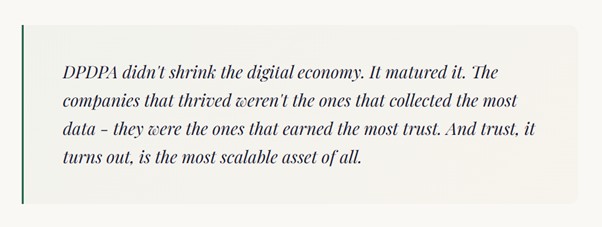
Cross-border
data flows, once a tangled web of uncertainty and legal grey areas, have been
clarified. India's adequacy agreements with other nations - built on the
credibility of its robust enforcement and the demonstrated rigour of its
compliance framework - have opened doors for Indian SaaS companies, IT service
providers, BPO firms, and digital health platforms to operate globally with
minimal friction. A healthtech startup in Chennai can now process anonymized
patient data from a partner hospital in Germany, because both sides trust the
framework that governs the exchange. An Indian fintech company can manage
financial data for clients in Singapore, because the regulatory bridge between
the two nations is built on a shared foundation of data protection standards.
And perhaps
most beautifully, DPDPA has unlocked innovation in ethical AI. When your
training data is clean - properly consented, purpose-limited, bias-audited, and
free from the shadow of unauthorized collection - your models are not just
legally sound. They're better. They're fairer. They produce fewer harmful
outputs. They reflect the diversity and complexity of the world more honestly.
India's AI companies, built on the bedrock of compliant data practices, are now
trusted partners for organizations worldwide who demand not just performance,
but integrity.
Even the
insurance and cybersecurity industries have been transformed. Cyber insurance
premiums for DPDPA-compliant organizations are significantly lower, because the
risk profile of a company that practices data minimization, purpose limitation,
and robust security is fundamentally different from one that hoards everything
and hopes for the best. Compliance doesn't just protect against legal risk. It
protects against operational risk, reputational risk, and the existential risk
of losing the trust that took years to build.
Chapter Six
The Global Impact: When India Led, the World Followed
India's full
embrace of DPDPA sent a signal that reverberated far beyond its borders. As the
world's most populous nation, one of its largest digital economies, and the
home of a technology services industry that touches every continent, India's
commitment to data protection didn't just protect its own citizens - it reset
global expectations for what a data protection framework could achieve.
Multinational
corporations, already navigating GDPR in Europe, CCPA in California, and a
patchwork of regulations elsewhere, found that India's framework offered
something genuinely different: a model that balanced protection with
pragmatism, enforcement with enablement. Unlike some regulations that seemed
designed primarily to punish, DPDPA felt designed to build. It acknowledged the
realities of a developing digital economy. It provided transition time. It
created sandboxes for innovation. And businesses responded. Global companies
didn't just comply for the Indian market; they adopted DPDPA's principles as a
baseline for their worldwide operations, because it was simpler - and smarter -
to build one high-standard system than maintain a dozen mediocre ones.
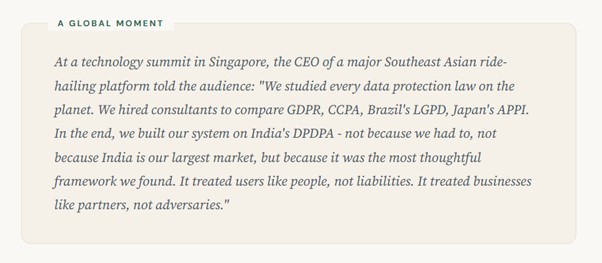
Developing
nations in Africa and Southeast Asia began modelling their own data protection
laws on DPDPA's framework, drawn to its clarity, its scalability, and its
emphasis on practical implementation over bureaucratic complexity. Kenya,
Vietnam, Nigeria, the Philippines - one by one, nations looked at India's
journey and saw a template that worked for large, diverse, rapidly digitizing
populations. India, long a technology service provider to the world, quietly
became something more profound: a standard-setter. A thought leader. A nation
that didn't just adopt global best practices but created them.
For Indian
businesses, the impact was transformative in ways that showed up directly on
balance sheets. The "trust premium" that came with operating under a
world-class data protection regime opened markets that had previously been
cautious - even reluctant - about outsourcing data-sensitive operations to
India. European healthcare companies, American financial institutions, Japanese
manufacturers, and Gulf-state government agencies began forging deeper
partnerships, confident that data shared with Indian partners was governed by a
framework they understood and respected.
The ripple
effect was cultural too. A generation of Indian technologists, raised in this
compliant world, carried privacy-first thinking into every product they built,
every startup they founded, every line of code they wrote, every architecture
decision they made. They didn't think of data protection as a constraint or a
compliance checkbox. They thought of it as craftsmanship. As quality. As the
difference between building something that lasts and building something that
eventually collapses under the weight of its own carelessness.
Chapter Seven
How It Feels to Live in a Secured Data World
This is the
hardest part to describe, because it's not about systems or laws or
certifications or compliance dashboards. It's about a feeling. A feeling that
permeates daily life so subtly that you almost don't notice it - until you
remember what came before.
It's the
feeling you get when you sign up for a new service and you're not bracing
yourself for the flood of spam calls, emails, and SMS messages that used to
follow within hours. It's the quiet confidence of knowing that the medical
records you shared with your doctor - your test results, your prescriptions,
your mental health notes - haven't been sold to an insurance company trying to
calculate your premium or a pharmaceutical advertiser trying to target you with
drugs you don't need. It's the simple dignity of being asked, honestly and
clearly, before someone uses something that belongs to you.
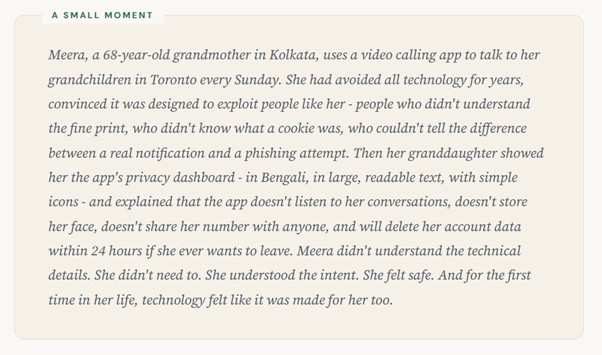
Living
in a secured data world feels like exhaling after years of holding your breath.
You didn't realize you were doing it - that low-grade, persistent anxiety of
wondering who's watching your searches, who's listening through your phone's
microphone, who's profiling your purchases, who's selling your location data to
strangers. It was the background noise of digital life, so constant that it
became normal. Until it stopped. And the silence was extraordinary.
Digital life
used to feel like walking through a crowded bazaar where every vendor was
secretly cataloguing your preferences, your vulnerabilities, your insecurities,
your habits - and using them to manipulate you into buying things you didn't
want, clicking on things you didn't need, and sharing things you didn't mean to
share. Now it feels like walking through a well-designed park. You're still
surrounded by services and offers and possibilities and innovations. But none
of them are reaching into your pockets without asking. None of them are
following you home. None of them are whispering your secrets to strangers.
There's a word
for this feeling, and it's not just "privacy." It's dignity. The
DPDPA, in its fullest realization, returned something to ordinary people that
the wild, unregulated, move-fast-and-break-things early decades of the internet
had quietly, systematically stolen: the right to exist digitally without being
exploited. The right to participate in the digital economy without surrendering
your identity as the price of admission.
And that,
perhaps, is the most extraordinary thing about this imagined world. It isn't
built on some impossible technology. It isn't utopia. People still lose their
phones. Companies still make mistakes. Systems still have bugs. But the
fundamental contract between people and technology has been rewritten. The
rules are fair. The systems are transparent. The enforcement is real. And
everyone - every company, every government body, every app developer, every
data processor - decided that the people behind the data mattered more than the
data itself.
Before & After DPDPA: The Transformation at a
Glance
|
Area
|
Before DPDPA
|
After DPDPA
|
|
Consent
|
Walls of legal text designed to confuse;
“Accept All as the only real option”
|
Clear, plain-language questions; granular
choices; no penalty for saying no
|
|
Spam & Telemarketing
|
Phone numbers sold across dozens of databases without knowledge
|
Data cannot be shared without explicit consent; spam calls drop
dramatically
|
|
Data Deletion
|
Requests ignored, delayed, or lost in support queues
|
Confirmed, timestamped deletion within defined timelines, irreversible
and verifiable
|
|
Children's Data
|
Behavioural tracking, targeted ads, and dark patterns aimed at minors
|
Verifiable parental consent required; behavioural profiling of
children banned
|
|
Grievance Redressal
|
Complaints vanished into automated response loops with no
accountability
|
Named, contactable DPOs; defined response timelines; Data Protection
Board as escalation
|
|
Business
Mindset
|
Data hoarded
as an asset: the more, the better
|
Data treated
as a responsibility and collect only what's needed, delete when
done
|
|
App Design
|
Privacy as an afterthought bolted on after launch
|
Privacy by design built in from Day One, not patched in after
|
|
Power Design
|
Users had no real visibility or control over their own data
|
Full dashboard access view, correct, download, or delete your data
anytime
|
|
Cross-Border Trust
|
Indian firms viewed with caution for data-sensitive global work
|
DPDPA compliance opens doors to EU, US, and Asia-Pacific partnerships
|
|
Children's Digital Experience
|
Minors profiled, tracked, and targeted from first click
|
Children use digital tools as children learning, not being harvested
|
Conclusion
Why We Need
to Act Now to Live in a Future Like This
Everything
you've just read is fiction. A story. A carefully imagined portrait of a world
that doesn't exist yet.
But here's the
thing - none of it is impossible. Not a single paragraph of this story requires
technology that hasn't been invented, laws that haven't been passed, or
principles that haven't been articulated. The Digital Personal Data Protection
Act, 2023 is real. It's on the books. Its provisions are clear. Its intent is
unambiguous. The only thing standing between the world we live in today and the
world described in these pages is action. Sustained, deliberate, committed
action - by businesses, by institutions, and by every individual who believes
they deserve better.
The gap between
the DPDPA's vision and today's reality isn't a matter of capability. It's a
matter of will. Every company that delays its compliance journey, hoping the
enforcement will be lenient or the deadlines will be extended, isn't just
taking a legal risk. It's delaying the arrival of a better world for its own
customers, its own employees, its own children. Every organization that treats
data protection as a checkbox rather than a transformation is choosing the old
world - the noisy, exploitative, trust-eroded world - over the one we all
deserve.

The early movers will be the ones who reap the greatest rewards - not just in
avoided penalties, but in customer trust, investor confidence, global market
access, and the operational clarity that comes from knowing exactly what data
you hold and why you hold it. The laggards will find themselves in an
increasingly inhospitable landscape, where customers, partners, and regulators
have all raised their expectations, and "we're working on it" is no
longer an acceptable answer.
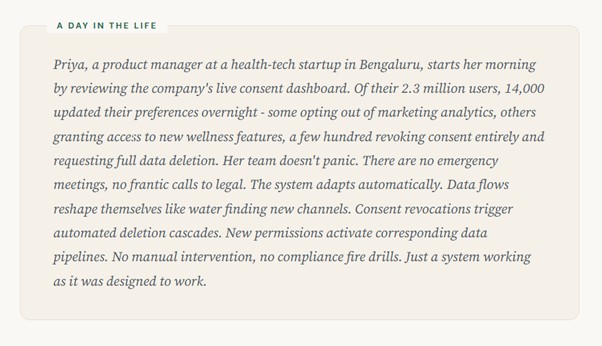
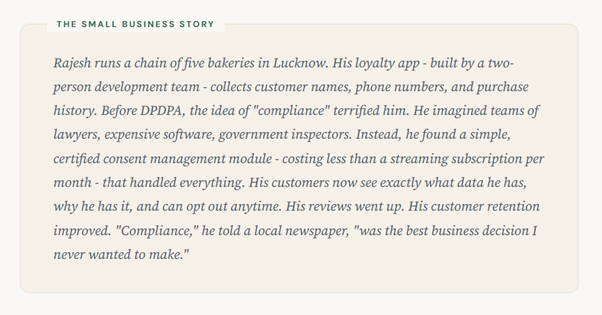
This future -
the one where Arjun's phone is quiet, where Meera feels safe calling her
grandchildren, where Priya's consent dashboard hums with automated efficiency,
where Rajesh's bakery app earns trust alongside croissants - this future is not
guaranteed. It is built. One compliance programme at a time. One
privacy-by-design decision at a time. One honest consent screen at a time.
The question
isn't whether this world will arrive. The momentum is already there - in the
legislation, in the market, in the expectations of a digitally aware generation
that will not accept the old bargain. The question is whether you'll be ready
when it does - whether you'll be a builder of this future or someone scrambling
to catch up while your competitors, your peers, and your customers have already
moved on.
The time to act
isn't tomorrow. It isn't next quarter. It isn't when the rules are
"finalized" or when the first major penalty makes headlines. The time
to act is now. Because the future described in these pages isn't just
desirable. It's inevitable. And the only choice you have is whether you'll help
build it - or be left behind by it.
Get Compliant Today
Reach out to DPDP Consultants - Your trusted partner for
end-to-end DPDPA compliance.
It wasn't a revolution. It
was a correction. And it was long overdue.