📌 TL;DR — Too Long; Didn't Read
- The deadline is approaching and compliance takes 6–18 months depending on company size, not days or weeks.
- The supply-demand gap is massive: there are far more companies needing compliance than available consultants and tools to help them.
- A last-minute rush will create a bottleneck. Quality consultants will be booked, costs will spike, and shortcuts will backfire.
- Penalties reach ₹250 crore per breach. The financial and reputational cost of non-compliance dwarfs the cost of early preparation.
- First-movers gain a competitive edge because consumer trust and business partnerships increasingly depend on provable data governance.
- Start now. Not next quarter. Now.
India's Digital Personal Data Protection Act (DPDPA) 2023 is not a distant regulatory cloud on the horizon. It is here. With implementing rules under active finalization and the Data Protection Board gearing up for operations, the compliance clock for every Data Fiduciary operating in India is officially running. Yet, walk into boardrooms across the country today and you'll find a troubling complacency, a "we'll get to it" attitude that mirrors the GDPR scrambles Europe saw in 2017–18. That didn't end well for thousands of European businesses. India's story doesn't have to repeat that mistake.
This blog makes the case, backed by data, timelines, and hard facts, for why the smartest move any business can make right now is to begin their DPDPA compliance journey immediately.

style="margin: 0px 0px 20px; padding: 0px; font-size: 17px;">Here is a number that should alarm every Indian business leader: India has well over a million companies that process personal data in some form, ranging from large multinationals to mid-sized SaaS firms to healthcare startups and e-commerce players. Every single one of them is a Data Fiduciary under the DPDPA if they collect, store, or process the personal data of Indian residents.
Now consider the supply side. The number of firms and independent consultants with genuine, hands-on DPDPA expertise is in the low hundreds at best. These are professionals who understand both the legal architecture of the Act and the technical implementation it demands. The broader privacy consulting market is growing, but the gap between demand and supply is enormous and will take years to close.
Supply vs. Demand: DPDPA Compliance Ecosystem (Estimated, 2026)

What does this gap mean in practice? It means that as the deadline hardens and enforcement becomes real, competent consultants will be booked solid. You will be left with a choice between waiting months for a credible firm to be available or hiring whoever is available, regardless of their qualifications. Neither option is good. Both are avoidable if you act now.
The same logic applies to compliance software and tools. India-specific DPDPA compliance platforms such as consent management tools, data mapping software, and Data Principal rights management portals are still an emerging category. Early adopters are shaping product roadmaps, getting priority onboarding, and locking in implementation support. Late movers will compete for limited implementation slots at inflated prices.
💡
The GDPR Lesson: In the months before the GDPR deadline in May 2018, consulting rates for privacy professionals in Europe doubled and tripled. Some firms were simply unable to get help at any price. The exact same dynamic will play out in India, but at a far larger scale given India's company base.
style="margin: 0px 0px 20px; padding: 0px; font-size: 17px;">One of the most dangerous misconceptions floating around Indian boardrooms is that DPDPA compliance is a documentation exercise. This is the idea that the legal team can knock it out in a few weekends. This is simply false. Genuine compliance is a cross-functional, organisation-wide transformation that touches IT, HR, Legal, Marketing, Procurement, and Customer Service simultaneously.
| Company Size | Estimated Compliance Duration | Key Complexity Drivers | Risk of Rushing |
|---|
| Startup / Small (<50 employees) | 3–6 months | Limited internal expertise; lean tech stack | Medium |
| Mid-Size (50–500 employees) | 6–9 months | Multiple data systems; vendor contracts; customer data at scale | High |
| Large Enterprise (500–5,000) | 9–14 months | Legacy IT, complex data flows, cross-border transfers, large workforce | Very High |
| Large-Scale Data Fiduciary | 12–18 months | Elevated obligations, DPO appointment, annual audits, DPIA requirements | Critical |
The timeline isn't arbitrary. Each phase of compliance has real prerequisites. You cannot implement a consent management system until you have completed a data mapping exercise. You cannot train employees until policies are drafted. You cannot assess third-party processors until you know which data flows exist. Everything is sequential, and there are no shortcuts that don't create legal exposure later.
M1
Month 1–2: Data Mapping & Gap Assessment
Inventory all personal data collected, processed, and stored. Identify lawful bases, map data flows, and assess current gaps against DPDPA requirements.
Month 3–4: Policy & Notice Framework
Draft Privacy Notice, Consent Artefacts, Data Retention Policy, Breach Response Policy, and internal data governance procedures.
Month 5–7: Technical Implementation
Deploy consent management, Data Principal rights portals, integrate privacy-by-design into product/systems, and update vendor contracts.
Month 8–10: Training & Awareness
Organisation-wide employee training, role-specific workshops for data handlers, DPO appointment and capacity building (where required).
Month 11–13: Audit, Testing & Remediation
Internal audit, third-party validation, penetration testing of new systems, remediation of identified gaps.
Month 14+: Ongoing Compliance Operations
Continuous monitoring, periodic DPIAs, annual reviews, responding to Data Principal requests within mandated timelines.
style="margin: 0px 0px 20px; padding: 0px; font-size: 17px;">History is remarkably consistent on this point. Whether it was GST implementation in India, GDPR in Europe, or HIPAA enforcement in the US, the pattern is always the same: nearly everyone waits until the last few months, then scrambles. The result is a predictable disaster for late movers.
Projected Compliance Adoption Curve: DPDPA (Modelled on GDPR Precedent)

Think about what happens in that last three-to-four month window before the deadline hardens. Every company that has been sitting on the sidelines suddenly wakes up and reaches for their phone at the same time. Consulting firms get flooded with enquiries overnight. Prices double. Implementation timelines stretch. Companies that once could have had a careful, well-implemented compliance programme end up with a rushed, surface-level exercise that doesn't hold up to scrutiny.
And here's the brutal irony: a compliance programme done in haste is often worse than no programme at all. Policies drafted without proper understanding of internal data flows create false assurances. Consent mechanisms deployed without testing create legal liability. An inadequate breach response policy discovered during an actual incident is catastrophic.
⚠️
Rushed compliance creates legal exposure, not protection. When the Data Protection Board investigates a complaint, they will look at whether your processes actually work and not merely whether they exist on paper. Companies that scrambled at the last minute will fail this test far more often than those who prepared methodically.
style="margin: 0px 0px 20px; padding: 0px; font-size: 17px;">Some compliance conversations are about theoretical risk. The DPDPA penalty framework is not theoretical. Parliament has built one of the steepest penalty structures of any data protection law in the world, with fines that can dwarf company revenues for mid-market businesses.
⚡ DPDPA Penalty Schedule
₹250 Crore
Failure to implement reasonable security safeguards resulting in personal data breach
₹200 Crore
Failure to notify Data Protection Board and Data Principals about a breach
₹200 Crore
Non-compliance with special provisions for processing children's data
₹10 Crore
Failure to maintain accuracy of personal data, honour erasure rights, or fulfil grievance mechanisms
For context: a ₹250 crore penalty for a mid-sized Indian company with ₹100–200 crore in annual revenue is not a fine. It is an extinction event. Even for larger organisations, fines of this magnitude trigger board-level accountability, investor flight, and reputational damage that lasts years.
The Data Protection Board is being built specifically to investigate, adjudicate, and penalise. It will have powers of a civil court, and early enforcement actions will be designed to send clear market signals. The very first high-profile penalty will transform boardroom conversations overnight. By then, the companies that acted early will already be protected.
style="margin: 0px 0px 20px; padding: 0px; font-size: 17px;">Beyond penalties, there is a business opportunity hidden inside the compliance imperative that most Indian companies are missing entirely. Data privacy is becoming a purchase criterion.
Enterprise B2B customers, especially those dealing with multinationals, international clients, or regulated sectors like BFSI, healthcare, and edtech, are already asking for data processing agreements, evidence of privacy practices, and certifications in their procurement processes. A company that can demonstrate DPDPA compliance in a vendor questionnaire today has a genuine competitive advantage over one that cannot.
Consumer & Enterprise Attitudes Toward Data Privacy (India, 2025–26 Survey Data)

On the B2C side, India's digital consumers are becoming progressively more aware of their rights. Following global privacy conversations, high-profile data breach news coverage, and growing media literacy, Indian consumers increasingly notice and reward businesses that treat their data with respect. A privacy-forward approach, communicated clearly in your product and marketing, is a differentiator that will only grow in importance.
style="margin: 0px 0px 20px; padding: 0px; font-size: 17px;">One of the most underestimated compliance challenges for established Indian businesses is the state of their existing technology infrastructure. Many companies across retail, manufacturing, BFSI, and healthcare are running on legacy systems such as CRMs, ERPs, databases, and marketing platforms that were never designed with data subject rights in mind.
The DPDPA mandates that Data Principals can:
- Access their personal data held by a Data Fiduciary
- Withdraw consent at any time
- Demand erasure of their data
- Nominate a person to exercise rights on their behalf
- File complaints with the Data Protection Board
Honouring these rights requires systems that can locate, retrieve, and delete a specific individual's data on demand across every system where that data exists. For companies with siloed databases, poorly documented data flows, and ageing tech stacks, building this capability is a significant engineering project. It cannot be done in a few weeks. It requires planning, resource allocation, technical scoping, development, and testing, all of which take time that companies sitting on the sidelines simply will not have.
style="margin: 0px 0px 20px; padding: 0px; font-size: 17px;">The DPDPA holds Data Fiduciaries responsible not just for their own data practices, but for ensuring that their Data Processors, which are the third-party vendors who process data on their behalf, also maintain adequate standards. This means reviewing and renegotiating contracts with every significant vendor: cloud providers, CRM vendors, analytics platforms, HR tech providers, payment gateways, logistics partners, and more.
For a mid-sized company, this typically means reviewing 20–50 vendor relationships. For a large enterprise, that number could be in the hundreds. Each review involves legal analysis, contract redlining, vendor questionnaires, and follow-up. Vendors themselves may need time to update their practices and provide the required assurances. Some may be unable to meet the required standards and may need to be replaced.
This is months of work, not weeks. And it cannot begin until after the internal data mapping exercise is complete, because you cannot review vendor contracts effectively until you know which vendors process which categories of data.
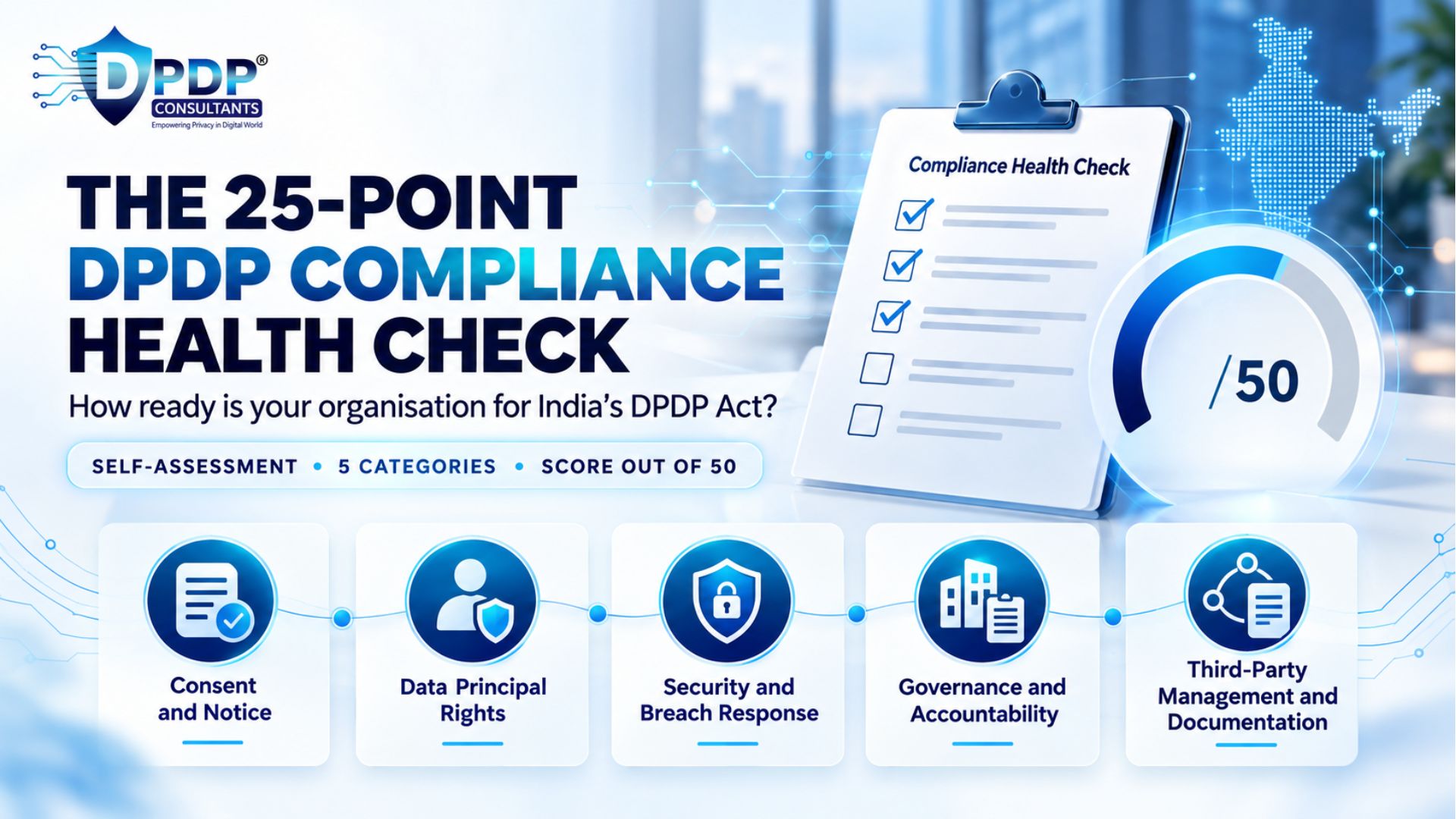
🗂️ DPDPA Compliance Readiness Checklist: Where Does Your Business Stand?
📋
Data Mapping CompletedHave you inventoried every category of personal data you collect, its purpose, storage location, and retention period?
📜
Privacy Notice UpdatedIs your privacy notice DPDPA-compliant, clear, accessible, and covering all required disclosures?
✅
Consent Mechanisms in PlaceDo you have granular, freely given, specific, and withdrawable consent for each processing purpose?
🔐
Security Safeguards ImplementedAre industry-standard technical and organisational security measures in place to prevent breaches?
👤
Data Principal Rights Portal ActiveCan individuals access, correct, or request erasure of their data through a functional mechanism?
📄
Vendor Contracts ReviewedHave all data processor agreements been updated to include DPDPA-required clauses?
🚨
Breach Response Policy ReadyIs there a documented, tested incident response plan with Board notification timelines?
🏫
Employee Training DoneHave employees who handle personal data been trained on their obligations under the DPDPA?
style="margin: 0px 0px 20px; padding: 0px; font-size: 17px;">Compliance is often framed purely as a cost and a burden. But the companies that move first on DPDPA will enjoy concrete advantages that late movers simply cannot replicate.
| Advantage | Early Movers | Late Movers |
|---|
| Consulting Access | Top-tier firms available; unhurried engagement | Scrambling for whoever is available |
| Cost | Standard market rates; time to negotiate | Premium pricing due to scarcity |
| Quality of Compliance | Methodical, tested, defensible | Rushed, surface-level, risky |
| Enterprise Sales | Can demonstrate compliance to prospects today | Losing deals to compliant competitors |
| Regulatory Standing | Good-faith effort visible to the Board | No demonstrated effort; higher penalty risk |
| Employee Confidence | Staff trained; culture of data responsibility | Rushed training; low retention, high risk |
Beyond these structural advantages, there is a regulatory goodwill dimension that is frequently overlooked. When the Data Protection Board begins enforcement, organisations that can demonstrate genuine, documented good-faith efforts at compliance, even if imperfect, will be treated materially differently from those with no programme whatsoever. Early movers are building that record now. Every month of inaction is a month of that record you're not building.
style="margin: 0px 0px 20px; padding: 0px; font-size: 17px;">Every point in this article leads to the same conclusion. Whether you look at it through the lens of supply constraints in the consulting market, the genuine time complexity of compliance, the penalty architecture, or the competitive opportunity, the answer is identical: the time to start is now, and every day of delay makes the eventual compliance journey harder, more expensive, and more risky.
The businesses that will navigate the DPDPA era successfully are the ones that treat this not as a deadline to avoid but as an opportunity to build trust with customers, resilience into systems, and a culture of responsibility around data. That kind of transformation doesn't come from a last-minute sprint. It comes from starting today.
🚀
Ready to begin? DPDP Consultants offers a complimentary DPDPA Readiness Assessment to help you understand exactly where your organisation stands and what your compliance roadmap should look like. The assessment takes two days. Compliance itself takes months. The only question is whether you start those months now or wait until it is too late.