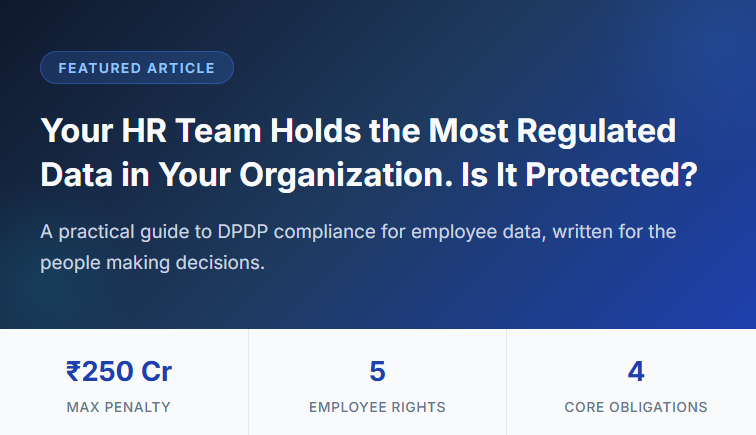
Your HR department holds the most sensitive data in your
organization, and most leadership teams haven't caught up with what that now
demands.
Salaries. Health records. Biometric data. Performance
reviews. Personal identification details. Every piece of employee data your HR
function touches now falls under the purview of India's Digital Personal Data
Protection (DPDP) Act, 2023, the country's first comprehensive data privacy
law.
For anyone in a leadership or decision-making role, this
isn't a compliance memo to pass along. It's a strategic risk, and handled well,
a strategic opportunity.
This guide breaks down what the DPDP Act means for your
people function, where most organizations are exposed, and what a credible
leadership response looks like.
What Employee Data Falls Under the DPDP Act?
The scope is broader than most decision-makers assume. Under
the Act, any information that can identify an individual, directly or
indirectly, qualifies as personal data. For the HR function, this covers
virtually everything it touches.
Employee Data Categories Covered by DPDP
|
Data
Category
|
Examples
|
Typical HR
Systems Involved
|
|
Recruitment
Data
|
Résumés,
background checks, interview evaluations, offer letters
|
ATS, Email,
Shared Drives
|
|
Employment
Records
|
Contracts,
compensation structures, bank details, tax declarations
|
HRMS, Payroll
Software
|
|
Sensitive
Personal Data
|
Health
records, disability disclosures, biometric data, insurance claims
|
Biometric
Systems, Benefits Platforms
|
|
Performance
& Conduct Data
|
Appraisals,
disciplinary records, promotion history, exit interview notes
|
HRMS,
Performance Management Tools
|
|
Digital
& Behavioral Data
|
Email
metadata, device logs, VPN usage, collaboration tool activity
|
IT Security,
Endpoint Management
|
If your HR systems were built in an era of "collect
everything, worry later," the DPDP Act has just made that approach a legal
liability.
The Four Core Obligations Every Organization Must Understand
As a Data Fiduciary, every organization is accountable for
each stage of the employee data lifecycle. Four obligations form the backbone
of that accountability.
1. Consent Must Be Explicit, Informed, and
Purpose-Specific
The Act requires that no personal data be collected without
a clearly communicated purpose and freely given consent. This is a fundamental
departure from how most organizations have operated.
What this means in practice: Every data collection
point, from HRMS onboarding workflows to health declaration forms to biometric
enrollment, must be accompanied by a clear, plain-language notice explaining what
is being collected, why it is needed, and how it will be used.
Consent cannot be buried in a 30-page employment agreement. It cannot be
assumed. It must be an affirmative, informed act.
The key takeaway: If your onboarding process hasn't
been redesigned with DPDP-compliant consent flows, you are already exposed.
2. Data Minimization Is Now a Legal Requirement
The Act mandates that organizations collect only the data
necessary for the stated purpose, nothing more.
What this means in practice: If you are running
payroll, you need bank details and tax identifiers, not an employee's complete
medical history. If you are managing attendance, basic biometric confirmation
may suffice; full fingerprint or iris scan databases may not be justifiable. Every
data field your HR systems capture needs to pass a simple test: Is this
necessary for the purpose we stated when we collected consent?
The key takeaway: Many legacy HRMS platforms were
designed to collect data expansively. A compliance-ready HR function requires a
deliberate audit of what is collected, why, and whether it can be defended
under the minimization principle.
3. Data Must Be Accurate, Current, and Subject to
Retention Limits
Employee data must be kept accurate and up to date for as
long as it serves its stated purpose, and deleted once that purpose is
fulfilled.
What this means in practice: Every organization needs
a formal, documented data retention policy with clear timelines. When does a
former employee's performance data get purged? How long are recruitment records
for unsuccessful candidates retained? What is the legal basis for holding
ex-employee records beyond the statutory minimum?
Holding onto data indefinitely "just in case" is
no longer a defensible position. It is a compliance violation.
The key takeaway: If the teams managing your HR data
cannot tell you, today, what your data retention timelines are and whether they
are being enforced, that is a gap that needs immediate attention.
4. Employee Data Rights Must Be Operationally Supported
The DPDP Act grants employees specific, enforceable rights
over their own data.
Employee Rights Under the DPDP Act
|
Right
|
What It
Means
|
Your
Operational Requirement
|
|
Right to
Access
|
Employees can
request a complete view of what personal data you hold on them
|
Centralized
data retrieval process with defined SLA
|
|
Right to
Correction
|
They can
demand that inaccurate or outdated data be corrected
|
Validation
workflow and update mechanism across systems
|
|
Right to
Withdraw Consent
|
Previously
granted consent can be revoked at any time
|
Systems must
honor withdrawal and cease processing
|
|
Right to
Erasure
|
Under defined
conditions, employees can request full data deletion
|
Automated or
auditable deletion across all repositories
|
|
Right to
Grievance Redressal
|
Employees can
raise complaints about data handling
|
Internal
grievance mechanism with documented response process
|
What this means in practice: These aren't theoretical rights. The HR
function must have defined processes, designated owners, and documented
response timelines for each of these requests. An employee submitting a data
access request should not trigger a scramble across five departments and three
spreadsheets.
The key takeaway: Operationalizing data rights is
where compliance becomes visible, both to employees and to regulators. It is
also where most organizations are least prepared.
Where Most Organizations Are Failing: Three Critical Gaps
Across industries, the same vulnerabilities surface
repeatedly. If your organization hasn't specifically addressed these, assume
they apply to you.
Organizational Readiness Gap Analysis
|
Gap
|
What We
See
|
Why It's
Dangerous
|
Typical
Root Cause
|
|
Fragmented
Data Ownership
|
Employee data
scattered across payroll, HRMS, shared drives, email inboxes, and vendor
systems
|
No single
owner, no consolidated view, no reliable audit trail
|
Siloed
systems, organic growth without data governance
|
|
Outdated
Consent Mechanisms
|
Employment
agreements drafted before DPDP, relying on broad and vague language
|
Consent does
not meet the Act's standard for specific, informed, purpose-limited
authorization
|
Legacy
documentation never updated post-legislation
|
|
No Data
Deletion Policy
|
Ex-employee
data (performance reviews, health records, PII) retained for years beyond
need
|
Accumulating
regulatory risk with every passing quarter
|
"Keep
everything" culture with no formal retention framework
|
The Action Plan: Five Steps to Start Now
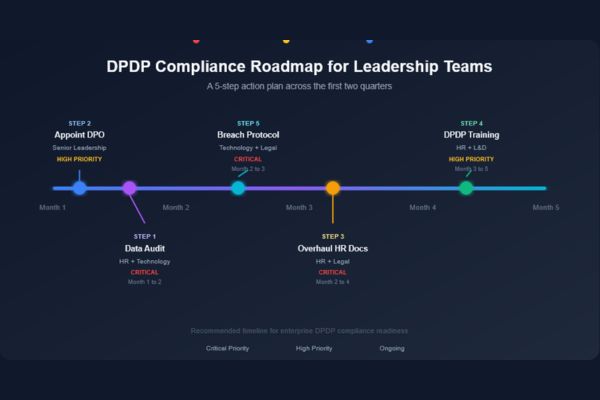
DPDP compliance is not a project to be delegated to a single
department. It is a leadership mandate that touches HR, legal, technology, and
operations. Here is a practical starting framework.
DPDP Compliance Roadmap
|
Step
|
Action
|
Key
Stakeholders
|
Priority
|
Timeline
|
|
1
|
Commission a
comprehensive data audit: map every category of employee data, where it
lives, who accesses it, and what legal basis supports retention
|
HR,
Technology, Legal
|
Critical
|
Month 1 to 2
|
|
2
|
Appoint a
Data Protection Officer (DPO) to serve as a single point of accountability,
even if not yet legally mandated for your organization
|
Senior
Leadership
|
High
|
Month 1
|
|
3
|
Overhaul HR
documentation and consent flows: update contracts, onboarding forms, benefits
enrollment, and vendor data processing agreements
|
HR, Legal
|
Critical
|
Month 2 to 4
|
|
4
|
Invest in
structured DPDP training for HR professionals, people managers, and system
administrators, not as a one-time session but as an ongoing initiative
|
HR, Learning
& Development
|
High
|
Month 3 to 5
|
|
5
|
Build a
breach response protocol: establish a documented incident response plan with
clear roles, escalation paths, and communication templates
|
Technology,
Legal
|
Critical
|
Month 2 to 3
|
The Strategic Case: Compliance as a Trust Multiplier
The organizations that treat DPDP compliance as a regulatory
burden will spend their time and budget reacting to investigations, penalties,
and reputational fallout.
The organizations that treat it as a strategic investment
will earn something far more durable: employee trust.
When employees know that their data is handled with
integrity, that the organization collects only what it needs, protects it with
rigor, and respects their rights over it, the employer-employee relationship
strengthens at its foundation. In a market where talent retention is a
persistent leadership priority, that trust is a measurable competitive
advantage.
DPDP compliance is not about avoiding fines. It is about
building an organization that the people inside it, and the regulators
overseeing it, can genuinely trust.
Your employee data strategy is now a governance strategy.
The question for your leadership team is not whether to act, but how
decisively.
Contact us for a free consultation at info@dpdpconsulants.com or
visit our website DPDP
Consultants