How India's landmark data protection law is rewriting the
rules of patient privacy, hospital compliance, and digital health.
India's healthcare ecosystem processes billions of sensitive
patient records annually — yet, until recently, there was no unified legal
framework mandating how this data must be protected. The Digital Personal Data
Protection (DPDP) Act 2023 changes everything. This comprehensive guide unpacks
its full impact on the healthcare sector.
1. What is the DPDP Act 2023?
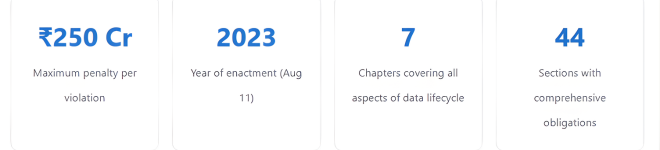
The Digital Personal Data Protection Act, 2023 (DPDP
Act) was enacted on August 11, 2023, and published in the Official Gazette of
India. It is India's first comprehensive, standalone legislation governing the
processing of digital personal data of individuals — called Data
Principals — by entities called Data Fiduciaries.
Key Definition
"Personal
data" under the DPDP Act means any data about an individual who is
identifiable by or in relation to such data. Health records, diagnostic
reports, prescriptions, genetic data, and mental health records all qualify as
personal data — and given their sensitivity, they attract the highest level of
protection.
The law applies to the processing of digital personal data
within India, as well as to processing outside India when it involves offering
goods or services to Data Principals in India. For the healthcare sector, this
is transformative: every hospital, diagnostic centre, telemedicine platform,
pharmacy chain, health insurance company, and medical AI application must
comply.
2. The Pre-DPDP Scenario: A Fragmented Framework
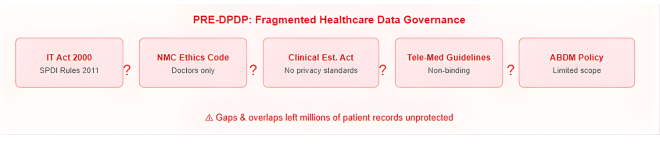
Before the DPDP Act, India lacked a comprehensive data
protection law. Healthcare data was governed by a patchwork of sector-specific
regulations and guidelines, leaving significant gaps in patient privacy
protections.
2.1 The Legal Patchwork
Prior to August 2023, health data governance was scattered
across multiple instruments:
- IT
Act 2000 & SPDI Rules 2011: The Sensitive Personal Data or
Information (SPDI) Rules under Section 43A of the IT Act offered limited
protection. Health information was listed as sensitive, but enforcement
was weak, penalties nominal, and coverage restricted to "body corporates."
- MCI
Code of Ethics (now NMC): Required doctors to maintain patient
confidentiality, but had no mechanism for digital data or third-party
processors.
- Clinical
Establishments Act, 2010: Mandated record-keeping but set no data
privacy or security standards.
- Telemedicine
Practice Guidelines, 2020: Introduced basic data protection for
telehealth but remained non-binding on many entities.
- ABDM
Health Data Management Policy: Applied only to the Ayushman
Bharat Digital Mission ecosystem — not universally.
Majorly, under the MCI Code of
Ethics Regulations (now governed by the National Medical Commission), medical
practitioners are required to retain patient records for a minimum period of three
years and ensure confidentiality. This requirement operates alongside the
Digital Personal Data Protection Act, 2023, which does not prescribe a fixed
retention period but mandates that personal data be retained only as long as
necessary for the purpose of processing, unless retention is required under
applicable law.
2.2 The Real-World Consequences
The Data Breach Reality
Multiple Indian healthcare data breaches went largely unpunished. In 2022,
records of over 3.7 crore patients at a major government health system were
reported exposed. Patient data was sold on the dark web. Insurance companies
and pharma firms routinely accessed patient data without explicit consent
through opaque data-sharing agreements with hospitals.
The absence of a unified law meant:
- Patients
had no formal right to access or correct their own health
records in digital systems.
- Consent
was often obtained through unreadable fine print or not at all.
- Third-party
health apps could harvest and sell user health data with minimal
accountability.
- Hospitals
outsourcing billing, diagnostics, or IT to third parties had no obligation
to ensure those parties protected patient data.
- Data
could be retained indefinitely with no obligation to delete it.
3. Post-DPDP: A New Order for Health Data
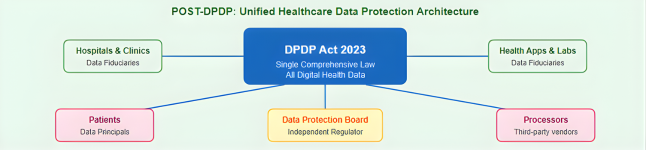
The DPDP Act fundamentally restructures how health data must
be handled. It introduces legally enforceable rights for patients, clear
obligations for healthcare providers, and an independent regulatory authority —
the Data Protection Board of India (DPBI) — to adjudicate
complaints and impose penalties.
The new framework introduces the concept of Significant Data
Fiduciaries (SDFs), which allows the Central Government to designate large
hospitals, hospital chains, health insurance companies, and health-tech
platforms as SDFs, subjecting them to heightened obligations including
mandatory Data Protection Impact Assessments (DPIAs), algorithmic audits, and
appointment of a Data Protection Officer (DPO).
4. Key DPDP Provisions Applicable to Healthcare
Core Principle
The
DPDP Act is built on the principle of "purpose limitation" — data
collected for treating a patient cannot be used for marketing, research, or any
other purpose without separate, explicit, and informed consent from the
patient.
4.1 Consent Requirements
Healthcare providers must obtain free, specific,
informed, unconditional, and unambiguous consent before collecting or
processing a patient's personal data. The consent request must be in clear,
plain language available in multiple languages. Patients must be told precisely
what data is being collected, why, how long it will be retained, and who it
will be shared with.
4.2 Notice Obligations
Prior to or at the point of collecting personal data, Data
Fiduciaries must provide a clear privacy notice. For hospitals, this means
intake forms, OPD registration, online appointment bookings, and telemedicine
platforms must all include compliant privacy notices — not buried in 40-page
terms and conditions, but in plain, accessible language.
4.3 Data Minimisation
Only data that is necessary for the specified purpose may be
collected. A hospital cannot collect a patient's social media profile
information or buying habits when treating them for diabetes. This principle
directly challenges the current practice of many hospital management systems
and CRM tools that collect excessive personal data.
4.4 Storage Limitation (Right to Erasure)
Data must not be retained beyond the period necessary for
the specified purpose. Once the purpose is served, the data must be deleted.
Healthcare institutions must establish clear data retention policies and
automated deletion schedules — a significant operational shift for most Indian
hospitals.
4.5 Data Localisation & Cross-Border Transfer
While the Act allows cross-border data transfers to notified
countries, health data — classified as sensitive personal data — may face
additional restrictions. Hospitals using international cloud services, offshore
diagnostic platforms, or global telemedicine networks must review their data
transfer mechanisms.
4.6 Data Security Standards
Data Fiduciaries must implement appropriate technical and
organisational security measures to prevent breaches. In healthcare, this means
encryption of patient records at rest and in transit, access controls, regular
security audits, and a documented incident response plan.
5. Before vs. After: Detailed Comparison
|
Aspect
|
🔴
Before DPDP Act
|
🟢
After DPDP Act
|
|
Patient
Consent
|
Routinely
absent or buried in opaque forms; verbal consent accepted without
documentation
|
Mandatory,
explicit, informed digital consent; purpose must be clearly stated; easy to
withdraw
|
|
Data
Access Rights
|
No formal
right to access digital health records; hospitals could deny without
consequence
|
Patients have
a statutory right to access all personal data held about them at any time
|
|
Right to
Correction
|
No legal
mechanism; patients had to rely on goodwill of hospital administration
|
Legal right
to correct inaccurate, incomplete, or outdated health data
|
|
Right to
Erasure
|
Hospitals
retained records indefinitely; no deletion obligations
|
Data must be
deleted when purpose is fulfilled; patients can request erasure
|
|
Third-Party
Sharing
|
Data freely
shared with pharma companies, insurers, and marketers without patient
knowledge
|
Requires
explicit separate consent; Data Processors contractually bound to DPDP
standards
|
|
Data
Breaches
|
No mandatory
reporting; most breaches went unreported; penalties negligible under IT Act
|
Mandatory
notification to DPBI and affected individuals; penalties up to ₹250 crore
|
|
Children's
Data
|
No special
protections; minors' health data treated like adult data
|
Verifiable
parental consent mandatory for children under 18; no behavioural tracking of
minors
|
|
Accountability
|
No single
regulatory body; enforcement fragmented across IT Ministry, MoHFW, SEBI (for
listed companies)
|
Data
Protection Board of India: centralised, independent adjudicator for all
complaints
|
|
Data
Minimisation
|
No
restriction; hospitals collected extensive unnecessary data for marketing and
analytics
|
Only data
necessary for stated medical purpose may be collected
|
|
Cross-Border
Transfer
|
Unrestricted;
health data could be sent to any country without patient knowledge
|
Permitted
only to notified countries; special scrutiny for sensitive health data
|
|
Grievance
Redressal
|
Consumer
courts, slow civil litigation; no dedicated mechanism for privacy violations
|
Fast-track
complaints to DPBI with statutory timelines; appellate tribunal available
|
|
DPO
Requirement
|
No
requirement; no dedicated officer for data privacy in most hospitals
|
Mandatory DPO
appointment for Significant Data Fiduciaries in healthcare
|
6. Why Compliance Benefits Hospitals
Many hospital administrators view DPDP compliance as a cost
centre. This is a misconception. Proactive compliance delivers measurable
business, legal, and reputational advantages.
6.1 Legal Risk Mitigation
The most immediate benefit is elimination of legal exposure.
With penalties reaching ₹250 crore per violation, a single patient data breach
at a non-compliant hospital can be existentially threatening. Compliance
converts this tail risk into manageable, foreseeable cost.
6.2 Competitive Differentiation
Patients are increasingly aware of their digital rights.
Hospitals that proactively communicate their DPDP-compliant practices — clear
privacy notices, easy consent withdrawal, secure portals — differentiate
themselves as trustworthy institutions, attracting privacy-conscious patients,
particularly for sensitive conditions like mental health, oncology, and
reproductive health.
6.3 Better Data Governance = Better Care
The data minimisation and purpose limitation principles
under DPDP essentially force hospitals to audit what data they actually collect
and use. This discipline typically surfaces data quality problems, eliminates
redundant data stores, and improves the accuracy of clinical information
systems — all of which contribute to better patient outcomes.
6.4 Stronger Vendor Contracts
DPDP compliance requires hospitals to execute robust Data
Processing Agreements (DPAs) with every vendor handling patient data — from
cloud providers and billing systems to diagnostic labs and insurance companies.
This reduces liability from third-party breaches and establishes clearer
operational accountability.
6.5 Trust with International Partners
Medical tourism, global clinical trials, and international
research collaborations require demonstrable data protection standards.
DPDP-compliant hospitals can more easily align with GDPR (EU), HIPAA (US), and
other international frameworks, opening doors for global partnerships.
Business Case
A 2024
survey by NASSCOM found that organisations with mature data governance
practices reported 23% fewer security incidents and 31% lower breach
remediation costs compared to non-compliant peers. For a 500-bed hospital, this
can translate to savings of ₹2–5 crore annually.
7. Rights & Benefits for Patients (Data Principals)
Under the DPDP Act, patients are empowered as Data
Principals with a suite of enforceable rights. These represent the
most significant expansion of patient rights in India's digital health history.
✅ Rights Granted to Patients
- Right
to access their personal health data
- Right
to correction of inaccurate records
- Right
to erasure (right to be forgotten)
- Right
to withdraw consent at any time
- Right
to grievance redressal
- Right
to nominate a representative
- Right
to know data processing details
- Right
against automated decision-making
❌ What Patients Gain Protection From
- Unauthorised
sharing with pharma/insurers
- Data
sold to medical marketers
- Indefinite
retention without consent
- Opaque
consent without disclosure
- Denial
of treatment for refusing data consent
- Children's
health data misuse
- Discrimination
based on health analytics
- Offshore
data transfers without knowledge
7.1 The Consent Manager: A Revolutionary Concept
The DPDP Act introduces the concept of a Consent
Manager — an accredited intermediary through whom patients can give,
manage, review, and withdraw consents across multiple Data Fiduciaries from a
single interface. For healthcare, this means a patient could manage consents
given to their hospital, diagnostic lab, insurance company, and health app all
in one place — a fundamental shift from the current siloed, paper-based consent
model.
"The patient's right to withdraw consent is not
limited by any condition imposed by the Data Fiduciary, and withdrawal shall be
as easy as giving consent."— DPDP Act, 2023, Section 6(4)
8. Penalties for Non-Compliance
Financial Exposure
Non-compliance is not a theoretical risk. The Data Protection Board of
India has the power to impose penalties without a cap on the number of
violations — a large hospital with multiple systemic failures could face
cumulative penalties far exceeding any single violation limit.
|
Violation
Type
|
Applicable
To
|
Maximum
Penalty
|
|
Failure to
implement reasonable security safeguards resulting in breach
|
All
healthcare Data Fiduciaries
|
₹250 Crore
|
|
Failure to
notify DPBI and affected patients of a data breach
|
All
healthcare Data Fiduciaries
|
₹200 Crore
|
|
Non-fulfilment
of additional obligations for Significant Data Fiduciaries
|
Large
hospital chains, national health platforms
|
₹150 Crore
|
|
Violation of
children's data protection obligations
|
Paediatric
hospitals, family health apps, school health portals
|
₹200 Crore
|
|
Non-fulfilment
of obligations of Data Processor
|
Diagnostic
labs, billing processors, health IT vendors
|
₹10 Crore
|
|
Failure to
honour patient rights (access, correction, erasure)
|
All
healthcare Data Fiduciaries
|
₹50 Crore
|
|
Obstruction
of DPBI's inquiry or investigation
|
All entities
|
₹10 Crore
|
9. Compliance Roadmap for Healthcare Institutions
Getting DPDP-compliant is not an overnight exercise. Here is
a phased roadmap that healthcare institutions of all sizes can follow:
Phase 1 — Months 1–2
Data Discovery & Mapping Audit
Identify every category of personal data collected across
all touchpoints — OPD, IPD, lab, radiology, pharmacy, insurance billing,
digital health app, website analytics. Map data flows including third-party
processors.
Phase 2 — Months 2–3
Gap Analysis & Risk Assessment
Compare current practices against DPDP requirements.
Identify gaps in consent management, security controls, third-party contracts,
and patient rights fulfilment. Conduct a Data Protection Impact Assessment
(DPIA).
Phase 3 — Months 3–5
Policy & Process Remediation
Draft and implement a Privacy Policy, Consent Management
Framework, Data Retention & Deletion Policy, Breach Response Plan, and
updated patient intake forms and digital consent flows.
Phase 4 — Months 5–6
Technical Implementation
Deploy encrypted data storage, access control systems, audit
logging, consent management software, and automated data deletion workflows.
Update HIS/EMR systems to support patient rights requests.
Phase 5 — Month 6+
Training, DPO Appointment & Ongoing Monitoring
Train all staff on DPDP obligations. Appoint/designate a
Data Protection Officer. Establish a Grievance Officer. Schedule quarterly
compliance reviews and annual DPIAs.
Compliance Checklist for Hospitals
- Conduct
full data mapping across all departments and vendors
- Update
patient registration forms with DPDP-compliant consent language
- Implement
digital consent management with easy withdrawal mechanism
- Draft
and publish an accessible Privacy Notice (in Hindi & English at
minimum)
- Audit
all third-party Data Processor agreements; execute DPDP-compliant DPAs
- Establish
a patient rights request portal (access, correction, erasure)
- Implement
and test a Data Breach Notification procedure
- Appoint
a Data Protection Officer (DPO) — mandatory for SDFs
- Conduct
a Data Protection Impact Assessment (DPIA) for high-risk processing
- Train
clinical, administrative, and IT staff on DPDP obligations
- Implement
encryption for all patient data at rest and in transit
- Establish
a data retention and deletion schedule aligned with DPDP and medical
records rules
10. Frequently Asked Questions
Q1. Does the DPDP Act apply to small clinics and solo
practitioners?
Yes, the DPDP Act applies to any entity that processes
digital personal data, including small clinics that use digital registration
systems, WhatsApp for appointment booking, or any electronic health records
system. However, the Government may provide exemptions for small entities
through the Rules, which are yet to be finalised. Solo practitioners relying
entirely on paper records fall outside the Act's scope until they go digital.
Q2. Can a hospital refuse treatment if a patient
withdraws consent for data processing?
No. Under the DPDP Act, consent for data processing that is
not necessary for the provision of medical treatment cannot be made a condition
for treatment. Patients must be able to withdraw consent for non-essential data
processing (e.g., marketing, research, sharing with third parties) without
affecting their access to care.
Q3. How does the DPDP Act interact with the Medical
Records Rules and Clinical Establishments Act?
The DPDP Act operates alongside existing medical records
retention requirements. Where specific medical records laws require data to be
retained for a minimum period (e.g., 3–7 years under various state rules),
those requirements continue to apply. The DPDP Act's storage limitation
principle means data cannot be retained beyond what is required by law and
clinical necessity — creating a maximum retention ceiling, not a minimum floor.
Q4. What constitutes "health data" under the
DPDP Act?
The DPDP Act itself classifies health data as a category of
sensitive personal data. This covers medical history, diagnoses, prescriptions,
lab reports, imaging data, genetic information, mental health records,
disability status, information about addiction, reproductive health data,
vaccination records, and any data that reveals physical or mental health status
— including inferences drawn from wearables and health apps.
Q5. When will the DPDP Act be fully enforced?
The DPDP Act was enacted on August 11, 2023. Full
enforcement awaits the publication of the DPDP Rules (draft rules were
published in January 2025) and the constitution of the Data Protection Board of
India. Healthcare institutions should use this period to complete their
compliance programmes, as enforcement is expected to begin progressively from
2025–2026 onwards.
Conclusion
The DPDP Act 2023 is not just another regulatory checkbox
for India's healthcare sector — it is a fundamental reset of the relationship
between patients and the institutions that hold their most sensitive
information. For hospitals and healthcare providers, compliance is both a legal
imperative and a strategic opportunity to build genuine trust with patients in
an era when digital health is exploding.
For patients, the Act represents the first time in India's
history that their digital health data has legal armour: clear rights, a
dedicated regulator, and meaningful penalties for those who violate their
privacy. The transition will not be instant or painless, but the direction is
unambiguous. Healthcare institutions that invest in compliance now will be
positioned as leaders in a future where patient trust is the most valuable
clinical asset.
Healthcare Policy Desk
Specialising in health law, data governance, and regulatory
compliance across India's digital health ecosystem. Covers MoHFW, NHA, and
emerging health-tech policy since 2018.
For legal advice specific to your institution's compliance needs, consult us at
info@dpdpconsultants.com